

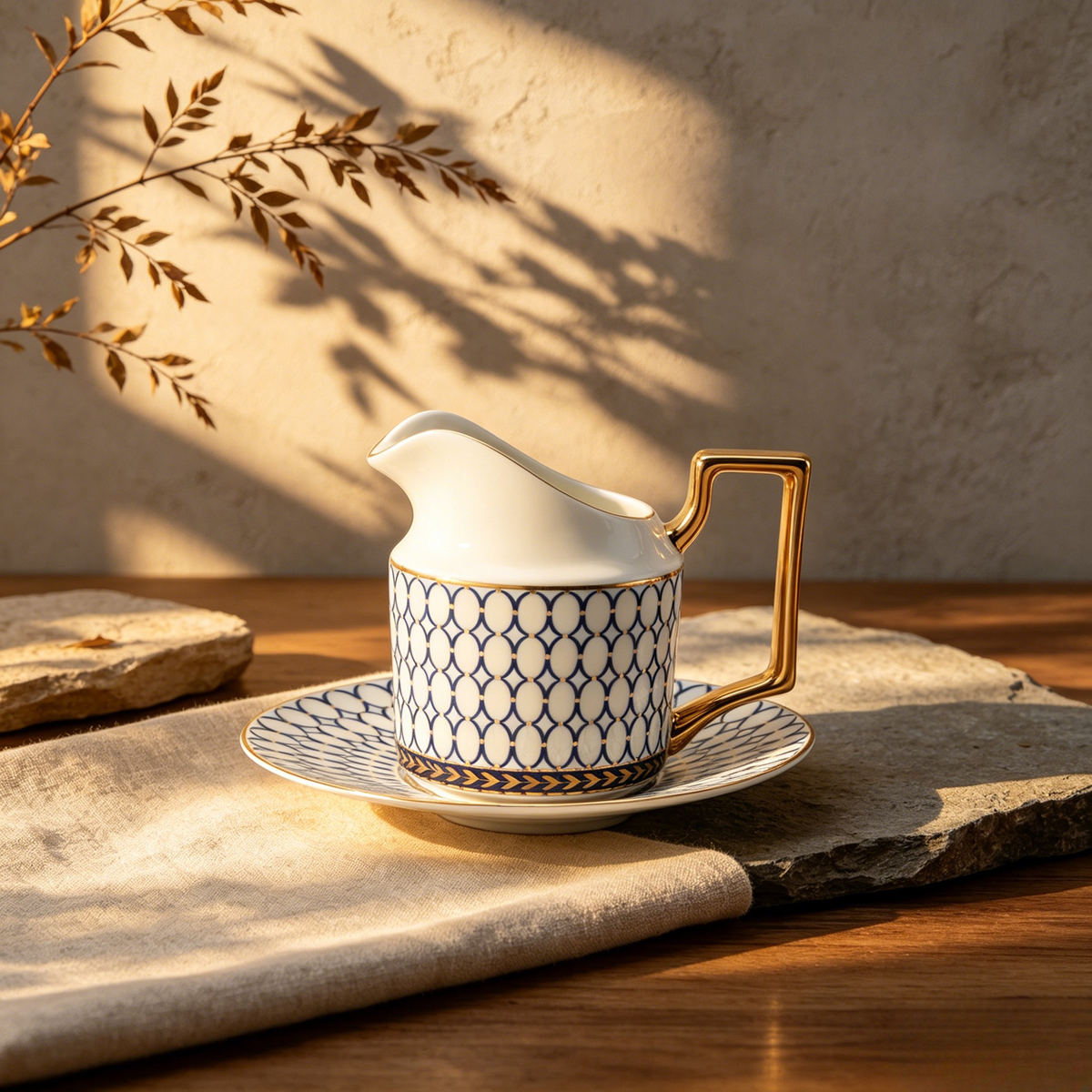
Bone china and porcelain are both fine ceramic materials used for tableware, tea sets, coffee cups, dinnerware, and decorative pieces. The main difference is composition: traditional bone china contains bone ash, while conventional porcelain does not necessarily contain it.
This difference in composition can influence the material's translucency, appearance, weight, feel, and manufacturing characteristics. However, neither material is automatically “better” in every situation. The right choice depends on how the tableware will be used and which qualities matter most.
For a quick overview:
| Characteristic | Bone China | Porcelain |
|---|---|---|
| Composition | Traditionally contains bone ash | Does not necessarily contain bone ash |
| Appearance | Often luminous and translucent | Smooth, refined, and often bright white |
| Translucency | Typically pronounced in thin pieces | Can also be translucent, depending on formulation and thickness |
| Weight | Often relatively lightweight | Varies by construction |
| Strength | Good strength relative to its thinness | Generally strong and durable |
| Surface | Smooth and refined | Smooth and often highly vitrified |
| Common uses | Tea sets, fine dinnerware, coffee cups, gifting | Dinnerware, tea ware, serving pieces, everyday tableware |
| Typical character | Delicate, refined, lightweight | Versatile, durable, refined |
The distinction is not simply “delicate bone china versus durable porcelain.” Both can be strong, high-quality ceramics when properly formulated and manufactured.
What Is Bone China?
Bone china is a fine ceramic material traditionally made with bone ash, kaolin clay, feldspathic materials, and other ceramic ingredients.
Bone ash is the defining component that distinguishes traditional bone china from many other types of porcelain.
The material is known for qualities such as:
-
Translucency
-
Smooth surface
-
Whiteness
-
Relatively lightweight construction
-
Fine, refined appearance
-
Good strength relative to its thinness
Because it can be formed into relatively thin pieces, bone china is particularly associated with teacups, saucers, tea sets, coffee cups, fine dinnerware, and formal table settings.
For a more detailed explanation, see [What Is Bone China?].
What Is Porcelain?
Porcelain is a broad category of fine ceramic material generally made from carefully prepared ceramic ingredients such as kaolin clay, feldspathic materials, and other minerals.
It is typically fired at high temperatures, producing a dense, hard, relatively non-porous ceramic body.
Porcelain can have a smooth surface, bright appearance, and varying degrees of translucency depending on its composition, thickness, firing process, and manufacturing technique.
It is widely used for:
-
Dinnerware
-
Plates and bowls
-
Tea sets
-
Coffee cups
-
Serving ware
-
Decorative ceramics
-
Architectural and technical applications
Unlike traditional bone china, porcelain does not inherently require bone ash.
Bone China vs. Porcelain: The Main Difference
The clearest distinction between bone china and porcelain is what goes into the ceramic body.
Traditional bone china contains bone ash.
Porcelain does not necessarily contain bone ash.
Both materials can contain kaolin and feldspathic materials, and both undergo high-temperature firing. Their different formulations, however, can produce differences in translucency, weight, texture, and overall appearance.
This is why bone china is often perceived as particularly delicate and refined, while porcelain is commonly associated with a broader range of applications.
However, these descriptions should not be treated as absolute rules. Modern formulations and manufacturing techniques vary significantly.
Bone China vs. Porcelain: Composition
Bone China
Traditional bone china typically contains:
-
Bone ash
-
Kaolin clay
-
Feldspathic materials
-
Other ceramic ingredients
Bone ash is the defining ingredient.
It contributes to the material characteristics associated with bone china, including translucency and its ability to form relatively thin, lightweight tableware.
Porcelain
Porcelain typically uses:
-
Kaolin clay
-
Feldspathic materials
-
Quartz or other mineral components, depending on formulation
-
Other ceramic ingredients
The exact composition varies between different porcelain formulations and manufacturing traditions.
This means “porcelain” describes a broader ceramic category rather than one single universal recipe.
Bone China vs. Porcelain: Translucency
Translucency is one of the most noticeable differences consumers associate with bone china.
A thin piece of bone china can allow light to pass through its body, producing a soft, luminous appearance.
This characteristic is influenced by:
-
Composition
-
Bone ash content
-
Body thickness
-
Firing conditions
-
Ceramic microstructure
Porcelain can also be translucent.
Very thin, high-quality porcelain can transmit light remarkably well, so translucency should not be treated as proof that a piece is bone china.
Instead, it is one characteristic among several.
Bone China vs. Porcelain: Weight
Bone china is often associated with a lighter feel.
Its formulation allows manufacturers to produce relatively thin tableware while maintaining useful strength. A bone china teacup can therefore feel surprisingly light in the hand.
Porcelain can also be lightweight, but its weight depends heavily on the thickness and construction of the individual piece.
For this reason, weight alone cannot reliably identify the material.
A thin porcelain cup may weigh less than a thick bone china cup.
Bone China vs. Porcelain: Strength and Durability
Both bone china and porcelain can be durable.
The idea that bone china is inherently fragile while porcelain is inherently strong is too simplistic.
Bone china can have good strength relative to its thinness, allowing manufacturers to create delicate-looking pieces that are suitable for regular use.
Porcelain is also known for its hard, dense, and durable ceramic body.
Actual durability depends on factors such as:
-
Material formulation
-
Firing conditions
-
Thickness
-
Shape
-
Glaze
-
Manufacturing quality
-
Handling
-
Decoration
The quality of the individual piece often matters as much as the general material category.
Bone China vs. Porcelain: Surface and Appearance
Both materials can have smooth, refined surfaces.
Bone china is often recognized for its luminous white body and subtle translucency. Its thin construction can give cups and plates an especially delicate visual profile.
Porcelain can also have a bright, smooth surface and can support a wide range of colors, glazes, and decorative techniques.
The visual difference is therefore usually one of degree and character rather than an absolute separation.
A high-quality porcelain piece can look just as refined as bone china, while a poorly made bone china piece may not have the appearance associated with fine tableware.
Bone China vs. Porcelain: Which Is Better for Tea Sets?
Both materials can be excellent for tea sets.
Bone china is particularly popular for formal tea service because its thin body, lightweight feel, translucency, and refined appearance complement the ritual of tea.
A fine bone china tea set may include:
-
Teacups
-
Saucers
-
Teapots
-
Dessert plates
-
Serving pieces
Porcelain tea sets are also widely used and can offer a different combination of weight, thickness, surface finish, and design.
If you are primarily interested in an elegant, lightweight tea service, bone china may appeal to you. If you prefer a broader range of ceramic styles and construction, porcelain offers many possibilities.
Explore our [Bone China Collection] for fine bone china tea sets and tableware.
Bone China vs. Porcelain for Everyday Use
Both materials can be suitable for everyday use.
The more important question is the construction and care requirements of the individual product.
When choosing everyday tableware, consider:
-
Thickness
-
Weight
-
Handle design
-
Glaze
-
Dishwasher compatibility
-
Microwave compatibility
-
Metallic decoration
-
Storage requirements
For example, a bone china cup with gold decoration may require more careful handling than an undecorated porcelain mug.
Similarly, a thick porcelain plate designed for everyday dining may be more practical for a particular household than a thin decorative bone china plate.
Material is only one part of the decision.
Bone China vs. Porcelain for Formal Dining
Bone china has a long association with formal dining, afternoon tea, fine hospitality, and giftware.
Its relatively thin body and luminous appearance can create an elegant table setting without requiring elaborate decoration.
Porcelain is equally capable of being used for formal dining.
Its versatility makes it suitable for both understated contemporary tableware and highly decorative traditional pieces.
The choice often comes down to the aesthetic and tactile qualities you prefer.
Bone China vs. Porcelain for Coffee Cups
Both materials work well for coffee cups.
Bone china can provide a lightweight, refined drinking experience, particularly in smaller cups and espresso cups.
Porcelain can provide a broader range of shapes and thicknesses, from thin specialty coffee cups to more substantial everyday mugs.
For coffee, consider the entire design rather than the material alone:
-
Cup capacity
-
Wall thickness
-
Rim shape
-
Handle
-
Heat retention
-
Weight
-
Decoration
A well-designed cup can perform beautifully regardless of whether it is made from bone china or porcelain.
Fine Bone China vs. Porcelain
Fine bone china is essentially a more specific term within the bone china category, emphasizing refinement, fineness, craftsmanship, or quality.
It should not automatically be treated as a completely separate material from bone china.
Fine bone china generally shares the same fundamental composition associated with traditional bone china, including bone ash combined with ceramic materials.
For more information, see [What Is Fine Bone China?].
Bone Porcelain China: What Does It Mean?
The phrase “bone porcelain china” can be confusing because the three words overlap in meaning.
-
Bone china is a specific type of fine ceramic traditionally containing bone ash.
-
Porcelain is a broader category of fine ceramic.
-
China is commonly used as a general term for porcelain or fine ceramic tableware.
In everyday retail language, these terms can sometimes be combined or used interchangeably.
For material accuracy, however, “bone china” is the more specific term when referring to traditional ceramic tableware containing bone ash.
How to Tell Bone China From Porcelain
Appearance alone is not always enough to identify the material.
If the manufacturer's specifications are available, they are the most reliable source.
You can also examine several characteristics.
Check the Label or Material Specification
Look for the manufacturer's stated material.
“Bone china” indicates a different composition from conventional porcelain.
Examine Translucency
Hold a thin section toward a light source.
Bone china often displays noticeable translucency, but high-quality porcelain can also transmit light.
Consider the Weight
Bone china is often relatively lightweight, but weight varies according to thickness and construction.
Look at the Body
Bone china often has a luminous, refined appearance.
Porcelain can also have a bright, smooth ceramic body.
None of these characteristics should be used alone as a definitive identification test.
Which Should You Choose: Bone China or Porcelain?
The answer depends on what you want from the tableware.
Choose Bone China If You Value:
-
A lightweight feel
-
Fine translucency
-
A delicate visual profile
-
Refined tea and coffee service
-
Formal or gift-worthy tableware
-
Fine decorative details
Choose Porcelain If You Value:
-
A broad range of styles
-
Dense, hard ceramic construction
-
Versatile everyday tableware
-
Different thicknesses and forms
-
Contemporary or traditional designs
These are tendencies rather than strict rules.
A high-quality bone china piece and a high-quality porcelain piece can both be excellent choices. The most useful comparison is between the specific products rather than between the material names alone.
Bone China vs. Porcelain: Quick Comparison
| Feature | Bone China | Porcelain |
|---|---|---|
| Bone ash | Traditionally included | Not necessarily included |
| Kaolin | Commonly used | Commonly used |
| Feldspathic materials | Commonly used | Commonly used |
| Translucency | Often pronounced | Can be pronounced |
| Weight | Often relatively light | Varies |
| Strength | Good strength relative to thinness | Generally strong and dense |
| Surface | Smooth and refined | Smooth and refined |
| Tea sets | Excellent choice | Excellent choice |
| Coffee cups | Excellent choice | Excellent choice |
| Fine dining | Commonly used | Commonly used |
| Everyday use | Possible, depending on design | Commonly used |
| Metallic decoration | Care may be required | Care may be required |
Frequently Asked Questions
Is bone china better than porcelain?
Neither material is universally better. Bone china and porcelain have different compositions and characteristics, and the better choice depends on the intended use, design, construction, and care requirements.
What is the main difference between bone china and porcelain?
The main difference is composition. Traditional bone china contains bone ash, while conventional porcelain does not necessarily contain it.
Is bone china stronger than porcelain?
Not necessarily. Both can be strong and durable. Bone china can offer good strength relative to its thinness, while porcelain is known for its hard, dense ceramic body.
Is bone china more expensive than porcelain?
Price varies widely depending on craftsmanship, design, decoration, brand, manufacturing method, and other factors. Material type alone does not determine price.
Is bone china more translucent than porcelain?
Bone china is often notably translucent, especially when formed into thin pieces. However, high-quality porcelain can also be translucent.
Can bone china be used every day?
Yes. Many bone china pieces are suitable for everyday use. Check the individual manufacturer's care instructions, especially when the piece contains gold or other metallic decoration.
Is fine bone china the same as bone china?
Fine bone china generally refers to refined or high-quality bone china. The term “fine” usually emphasizes the characteristics and craftsmanship of the finished tableware rather than identifying an entirely different ceramic material.
Which is better for tea sets, bone china or porcelain?
Both can work well for tea sets. Bone china is often chosen for its lightweight feel, translucency, and refined appearance, while porcelain offers a wide range of forms, finishes, and construction styles.
Understanding the Difference
The simplest way to understand bone china versus porcelain is to start with composition.
Traditional bone china contains bone ash. Porcelain does not necessarily contain bone ash.
From that fundamental difference come potential variations in translucency, weight, appearance, and tactile character.
But the material name is only the beginning.
The quality of the raw materials, formulation, firing process, thickness, glazing, craftsmanship, and decoration all influence the final piece. A carefully made porcelain cup can be exceptionally refined, just as a well-made bone china cup can combine delicacy with practical strength.
For tea, coffee, dining, and entertaining, the best choice is ultimately the material and design that fit the experience you want to create.
Explore the [Blissful Reserve Bone China Collection] for fine bone china tea sets, cups, and tableware designed around refined materials, considered proportions, and timeless elegance.
Related Guides
-
[What Is Bone China?] — Learn the definition, characteristics, and common uses of bone china.
-
[What Is Fine Bone China?] — Understand fine bone china and how it relates to bone china and porcelain.
-
[What Is Bone China Made Of?] — Explore bone ash, kaolin, feldspathic materials, and the manufacturing process.
-
[Bone China Tea Sets] — Discover fine bone china tea sets for afternoon tea and everyday rituals.