


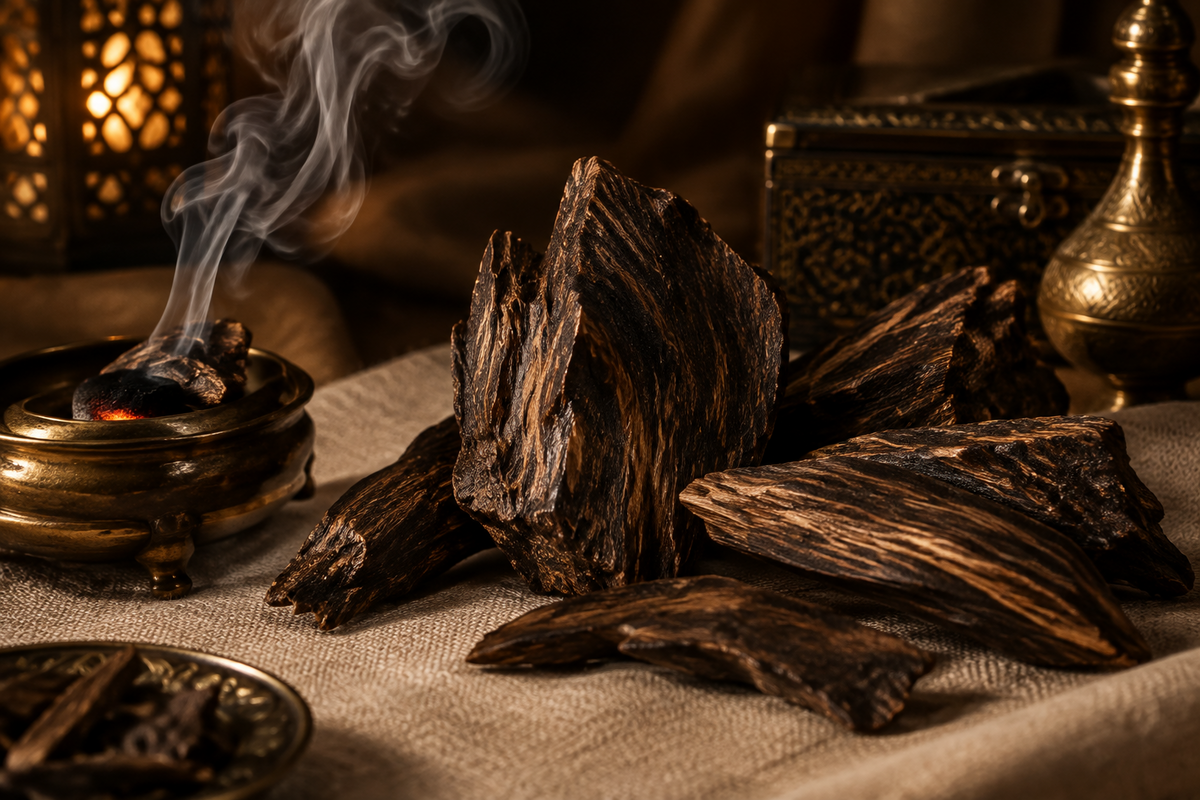
What Is Agarwood? Origins, Resin, Aroma & Traditional Uses
Agarwood is a fragrant resinous wood formed in certain Aquilaria trees when the tree responds to injury, stress, or microbial activity by producing aromatic resin. Unlike ordinary wood, resin-rich agarwood develops a distinctive fragrance that can be woody, warm, sweet, earthy, balsamic, or subtly spicy.
For centuries, agarwood has been valued across South and Southeast Asia and the Middle East for incense, perfumery, and traditional cultural practices. It is also closely associated with oud, a term commonly used for aromatic material and oil derived from resinous agarwood.
But what exactly is agarwood, how does it form, and why is it so highly valued?
What Is Agarwood?
Agarwood refers to aromatic, resin-rich wood that develops in certain trees of the Aquilaria genus.
It is important to distinguish the tree from the material. Aquilaria is a genus of trees, while agarwood is the resinous wood that can develop within some of these trees. An Aquilaria tree does not consist entirely of agarwood. Most of its wood may remain relatively light and non-aromatic, while resin accumulates in particular areas over time.
The characteristic fragrance of agarwood comes primarily from aromatic compounds associated with this resin.
The amount, distribution, and composition of resin can vary considerably. As a result, different pieces of agarwood can have very different appearances, densities, and fragrance profiles.
This variation is one reason agarwood is considered a distinctive natural aromatic material rather than simply a type of fragrant wood.
How Does Agarwood Form?
Agarwood formation is associated with the natural defense response of certain Aquilaria trees.
When a tree experiences injury, environmental stress, or microbial activity, it can respond by producing resinous compounds around affected areas. Over time, these compounds accumulate within the wood.
The general process can be understood as:
Aquilaria tree → injury or stress → defensive response → resin formation → resin-rich aromatic wood
The process is not instantaneous. Resin can develop gradually, and its distribution throughout the wood may be uneven.
This is also why ordinary Aquilaria wood and resin-rich agarwood are not interchangeable. The presence and characteristics of aromatic resin are what give agarwood its distinctive value and fragrance.
Modern cultivation can also encourage resin formation in managed Aquilaria trees. Cultivated agarwood should not automatically be considered artificial or inferior; its characteristics depend on the tree, cultivation conditions, resin formation, and subsequent processing.
What Is Agarwood Resin?

Agarwood resin is the aromatic resinous material that accumulates within certain Aquilaria trees and gives resin-rich wood its characteristic fragrance.
The resin contains a complex mixture of aromatic compounds. Their composition can vary according to factors such as species, geographic origin, tree condition, and the way the wood develops.
This helps explain why agarwood does not have a single standardized scent.
Some pieces may have a soft sweetness, while others can be deeper and more balsamic, earthy, woody, smoky, or subtly spicy.
Resin content is an important characteristic when evaluating agarwood, but it is not the only factor that determines its quality or fragrance. Origin, species, aroma profile, density, age, and processing can also influence the final material.
What Does Agarwood Smell Like?
Agarwood can have a remarkably complex aroma.
Common descriptions include:
-
Woody — deep, dry, and natural
-
Resinous — rich, warm, and balsamic
-
Sweet — soft and rounded rather than simply sugary
-
Earthy — grounded and slightly mineral-like
-
Smoky — particularly noticeable when the wood is heated or burned
-
Spicy — subtle aromatic notes that can add complexity
There is no single “agarwood smell.” Different species, origins, resin compositions, and preparation methods can produce noticeably different aromatic profiles.
When used as incense, the fragrance can also develop gradually as the material is heated. The initial aroma may differ from the deeper notes that emerge later.
This layered character is one of the reasons agarwood has remained important in incense and perfumery.
Where Does Agarwood Grow?
Agarwood-producing Aquilaria species are native to parts of South and Southeast Asia.
Depending on the species, Aquilaria trees can be found in regions including:
-
India and Northeast India
-
Bangladesh
-
Myanmar
-
Thailand
-
Laos
-
Vietnam
-
Cambodia
-
Malaysia
-
Indonesia
The term “agarwood” therefore describes a material associated with several Aquilaria species and geographic regions rather than a single geographical source.
Regional differences can influence the characteristics of the resulting resinous wood. Species, climate, soil, tree age, resin formation, and processing methods can all contribute to differences in aroma.
Laos, for example, is one of the Southeast Asian regions associated with Aquilaria and agarwood production.
Why Is Agarwood Used for Incense?

Agarwood has a long history of use as incense because of the distinctive fragrance released from its aromatic resin when heated.
Unlike ordinary wood, resin-rich agarwood can produce a complex aromatic experience that develops as it warms. Depending on the material, the fragrance may move from woody and earthy notes toward warmer, sweeter, balsamic, or smoky nuances.
Agarwood has traditionally been used in a variety of cultural and contemplative settings, including:
-
incense ceremonies
-
religious and spiritual practices
-
meditation
-
hospitality
-
personal fragrance
-
traditional cultural rituals
Today, agarwood can be encountered in several forms, including wood chips, powders, incense preparations, and fragrance materials.
For incense, the quality and composition of the raw material matter greatly. The fragrance of an agarwood incense product therefore depends not only on the name “agarwood,” but also on the source of the wood, resin content, formulation, and burning or heating method.
Agarwood and Oud: Are They the Same?
Agarwood and oud are closely related, but the terms are not always interchangeable.
Agarwood generally refers to the resinous aromatic wood that develops in certain Aquilaria trees.
Oud, particularly in perfumery, commonly refers to aromatic material or oil derived from resinous agarwood. The word can also be used more broadly in fragrance and incense contexts.
A simple way to understand the relationship is:
Aquilaria tree → resin formation → agarwood → oud oil / oud fragrance materials
However, terminology can vary between the incense, raw-material, and perfume industries.
This is why the phrases agarwood, oud, and agarwood oud may appear together while referring to related but not necessarily identical materials.
How Is Agarwood Used Today?
Agarwood continues to be used in both traditional and contemporary contexts.
Incense
Agarwood is used in incense sticks, chips, powders, and other aromatic preparations. Its resinous fragrance makes it particularly valued for slow, contemplative fragrance experiences.
Perfumery
Agarwood-derived materials are used in traditional and modern perfumery. Oud has become particularly recognizable as a fragrance category, although the character of oud can vary considerably depending on the source and extraction or formulation method.
Cultural Practices
Agarwood has a long history in cultural and ceremonial practices across parts of Asia and the Middle East. Its fragrance has traditionally been associated with hospitality, ritual, contemplation, and special occasions.
Everyday Fragrance Rituals
Today, agarwood incense can also be used simply as part of a personal home ritual: creating a quiet atmosphere, marking the transition from work to rest, or adding depth to a living space.
Natural Agarwood vs. Cultivated Agarwood
The terms natural agarwood and cultivated agarwood describe different ways in which resinous material may develop or be produced.
Natural agarwood refers to resinous wood that forms in an Aquilaria tree through naturally occurring processes. Highly resinous naturally formed agarwood can be difficult to obtain and has historically been subject to intensive harvesting.
Cultivated agarwood comes from managed trees, often in plantations or other controlled growing environments. Various techniques may be used to encourage resin formation.
Cultivated does not necessarily mean artificial.
The quality and fragrance of agarwood depend on factors such as the Aquilaria species, growing conditions, resin formation, geographic origin, and processing. A simple distinction between “wild” and “cultivated” is therefore not enough to determine the character of a particular piece of agarwood.
Why Is Agarwood Valuable?
Agarwood is valued because its formation is relatively specific and its fragrance can be unusually complex.
Several factors can influence its value:
-
Resin content
-
Aroma profile
-
Aquilaria species
-
Geographic origin
-
Density and appearance
-
Age and development of the resin
-
Processing and preparation
Not every Aquilaria tree develops the same amount of aromatic resin, and even within a single tree, resin may be concentrated in particular areas.
The result is a natural material with considerable variation from one source to another.
Frequently Asked Questions About Agarwood

What is agarwood made from?
Agarwood is resin-rich wood that forms in certain Aquilaria trees. Its characteristic fragrance comes from aromatic compounds associated with the resin that develops within the wood.
Is agarwood a tree?
No. Agarwood is not a tree species. It is aromatic, resin-rich wood that can develop in certain Aquilaria trees.
Is agarwood the same as oud?
Not exactly. Agarwood generally refers to the resinous wood itself, while oud commonly refers to aromatic material or oil derived from agarwood, particularly in perfumery. The terminology can vary by context.
What does agarwood smell like?
Agarwood can smell woody, resinous, sweet, earthy, balsamic, smoky, or subtly spicy. Its aroma varies according to species, geographic origin, resin composition, and preparation.
Where is agarwood found?
Agarwood-producing Aquilaria species are found primarily across parts of South and Southeast Asia, including regions of India, Bangladesh, Myanmar, Thailand, Laos, Vietnam, Cambodia, Malaysia, and Indonesia.
Why is agarwood used for incense?
Agarwood is used for incense because its resin produces a distinctive and complex fragrance when heated. Its aroma has been valued in cultural, ceremonial, and contemplative practices for centuries.
Is natural agarwood rare?
Highly resinous natural agarwood can be difficult to obtain. Aquilaria populations have also faced significant harvesting pressure, which has contributed to the development of cultivated production.
Is agarwood the same as agarwood incense?
No. Agarwood is the aromatic resinous wood itself, while agarwood incense is an incense product made using agarwood or agarwood-derived aromatic materials.
Discover Laos Agarwood Incense
Agarwood is ultimately more than simply a fragrant wood. It is the result of a complex relationship between Aquilaria trees, resin formation, geography, and time.
Its distinctive aroma has allowed agarwood to remain relevant across centuries, from traditional incense practices to contemporary fragrance and home rituals.
For those who want to experience agarwood as incense, explore our [Laos agarwood incense] collection, created around the warm, resinous character of agarwood and the quiet atmosphere of a considered home ritual.