

When choosing espresso cups, material is one of the most important decisions to make.
You will often see cups described as ceramic, porcelain, bone china, or other specialized materials. But what is the actual difference between them?
More importantly, are ceramic espresso cups better than porcelain espresso cups for coffee?
The answer depends on what you value.
Ceramic is a broad category of fired clay-based materials, and porcelain is actually a specific type of ceramic known for its refined body, smooth surface, and often lighter appearance. Within that broader category, different formulations and manufacturing techniques can produce very different results.
For espresso cups, the choice comes down to a combination of material composition, wall thickness, heat behavior, durability, craftsmanship, finish, and aesthetic preference.
Ceramic vs. Porcelain: The Basic Difference
The first thing to understand is that "ceramic" and "porcelain" are not completely separate categories.
Ceramic is the broader term for objects made from clay and other mineral materials that are shaped and then hardened through firing.
Porcelain is a specialized ceramic material traditionally associated with carefully refined mineral ingredients and high-temperature firing. It is generally known for its smooth surface, fine appearance, and relatively low porosity.
This means that porcelain espresso cups are ceramic espresso cups in the broader technical sense.
When shoppers compare ceramic vs porcelain espresso cups, they are usually comparing different types of ceramic bodies rather than two entirely unrelated materials.
What Are Ceramic Espresso Cups Made From?
Ceramic tableware can be made from different clay bodies and mineral compositions.
Depending on the type of ceramic, the body may contain different proportions of clay, feldspathic materials, silica, and other ingredients.
The manufacturing process also matters.
Two ceramic cups can have very different characteristics depending on:
-
Clay composition
-
Firing temperature
-
Wall thickness
-
Glaze
-
Manufacturing technique
-
Surface treatment
-
Decorative finishing
This is why simply seeing the word "ceramic" on a product page does not tell you everything about the quality of the cup.
What Is Porcelain?
Porcelain is a refined ceramic material with a long history in tableware and decorative arts.
It is typically associated with:
-
A smooth surface
-
Fine texture
-
Relatively low porosity
-
Refined appearance
-
Light-colored or white bodies
-
High-temperature firing
Porcelain can produce exceptionally elegant tableware, which is one reason it is frequently used for formal tea and coffee services.
However, porcelain is not automatically "better" than every other ceramic.
The quality of the finished espresso cup depends on the formulation, craftsmanship, firing, glaze, construction, and finishing—not simply the label printed on the product description.
Ceramic vs. Porcelain Espresso Cups
So how do the two compare when used for espresso?
| Feature | Ceramic Espresso Cups | Porcelain Espresso Cups |
|---|---|---|
| Material category | Broad ceramic category | Specialized ceramic |
| Appearance | Wide range of finishes | Often fine and refined |
| Texture | Depends on clay body and glaze | Typically smooth and fine |
| Design flexibility | Very high | Very high |
| Weight | Varies considerably | Often lighter for comparable forms |
| Heat behavior | Depends on body and thickness | Depends on body and thickness |
| Durability | Depends on construction | Depends on construction |
| Decorative potential | Excellent | Excellent |
| Best suited to | Wide range of styles | Refined tableware and formal settings |
The important takeaway is that material alone does not determine espresso cup quality.
A well-made ceramic cup can outperform a poorly made porcelain cup in the areas that matter to you.
Which Is Better for Espresso?
There is no universal winner between ceramic and porcelain.
For espresso, the more important question is whether the cup is appropriately designed for a small, concentrated serving.
Look at:
-
Capacity
-
Wall thickness
-
Thermal properties
-
Shape
-
Rim design
-
Handle
-
Surface finish
-
Overall craftsmanship
A well-designed ceramic espresso cup can provide excellent performance.
A well-made porcelain espresso cup can do the same.
The choice often comes down to the character you want from the cup.
Why Ceramic Works Well for Espresso
Ceramic has several characteristics that make it particularly versatile for espresso cups.
Thermal Stability
The thermal behavior of a ceramic cup depends on its specific body, thickness, and temperature before use.
A substantial ceramic wall can help moderate heat transfer between the espresso and the surrounding environment.
Weight and Feel
Ceramic cups can have a satisfying weight in the hand, particularly when designed with a substantial body.
For a small 2 oz espresso cup, this can create an interesting contrast: the serving is compact, but the vessel still feels substantial.
Decorative Flexibility
Ceramic is exceptionally versatile when it comes to surface treatments.
It can be glazed, textured, painted, gilded, patterned, or finished in a wide variety of ways.
This makes ceramic particularly suitable for espresso cups where function and decorative design are intended to coexist.
Why Porcelain Works Well for Espresso
Porcelain has its own advantages.
Its smooth, refined surface can create an elegant presentation for espresso. The material is also widely associated with fine tableware and formal dining.
For people who prefer:
-
A lighter visual appearance
-
Fine, smooth surfaces
-
Classic tableware aesthetics
-
Formal coffee or tea service
porcelain can be an excellent choice.
However, a porcelain cup does not automatically provide better heat retention simply because it is porcelain.
Cup thickness, mass, starting temperature, and construction still matter.
What Is the Best Material for Espresso Cups?
If you are asking for the best material for espresso cups, there is no single answer that applies to every drinker.
Instead, consider the characteristics you value.
Choose ceramic if you value:
-
A substantial feel
-
Broad design possibilities
-
Decorative finishes
-
A more handcrafted character
-
A wide range of shapes and styles
Choose porcelain if you value:
-
Fine, smooth surfaces
-
A refined appearance
-
Traditional fine-tableware aesthetics
-
A lighter visual character
And remember that these categories can overlap. Porcelain is itself a type of ceramic.
The quality of the individual cup matters more than the label alone.
What Is Kaolin Clay?
Kaolin clay is particularly relevant when discussing fine ceramic and porcelain products.
Kaolin is a naturally occurring white clay valued for its mineral composition and suitability for producing refined ceramic bodies.
It has a long association with porcelain production and other fine ceramic applications.
For an espresso cup, the presence of kaolin clay is only one part of the story. The final characteristics of the cup also depend on the complete material formulation, firing process, glaze, construction, and finishing.
This is an important distinction when evaluating premium ceramic tableware.
A material ingredient does not exist in isolation; craftsmanship determines how that material becomes a finished object.
What Is a Ceramic Glaze?
The surface of a ceramic cup is often shaped significantly by its glaze.
A glaze is a glass-like coating that is fused to the ceramic surface during firing.
It can influence:
-
Surface texture
-
Appearance
-
Gloss
-
Color
-
Feel
-
Water resistance
-
Decorative character
Different glaze formulations can produce dramatically different results even when the underlying ceramic body is similar.
For espresso cups, the glaze is particularly important because it forms much of the surface that the user sees and touches.
Lu Bao Glaze and the Character of a Ceramic Cup
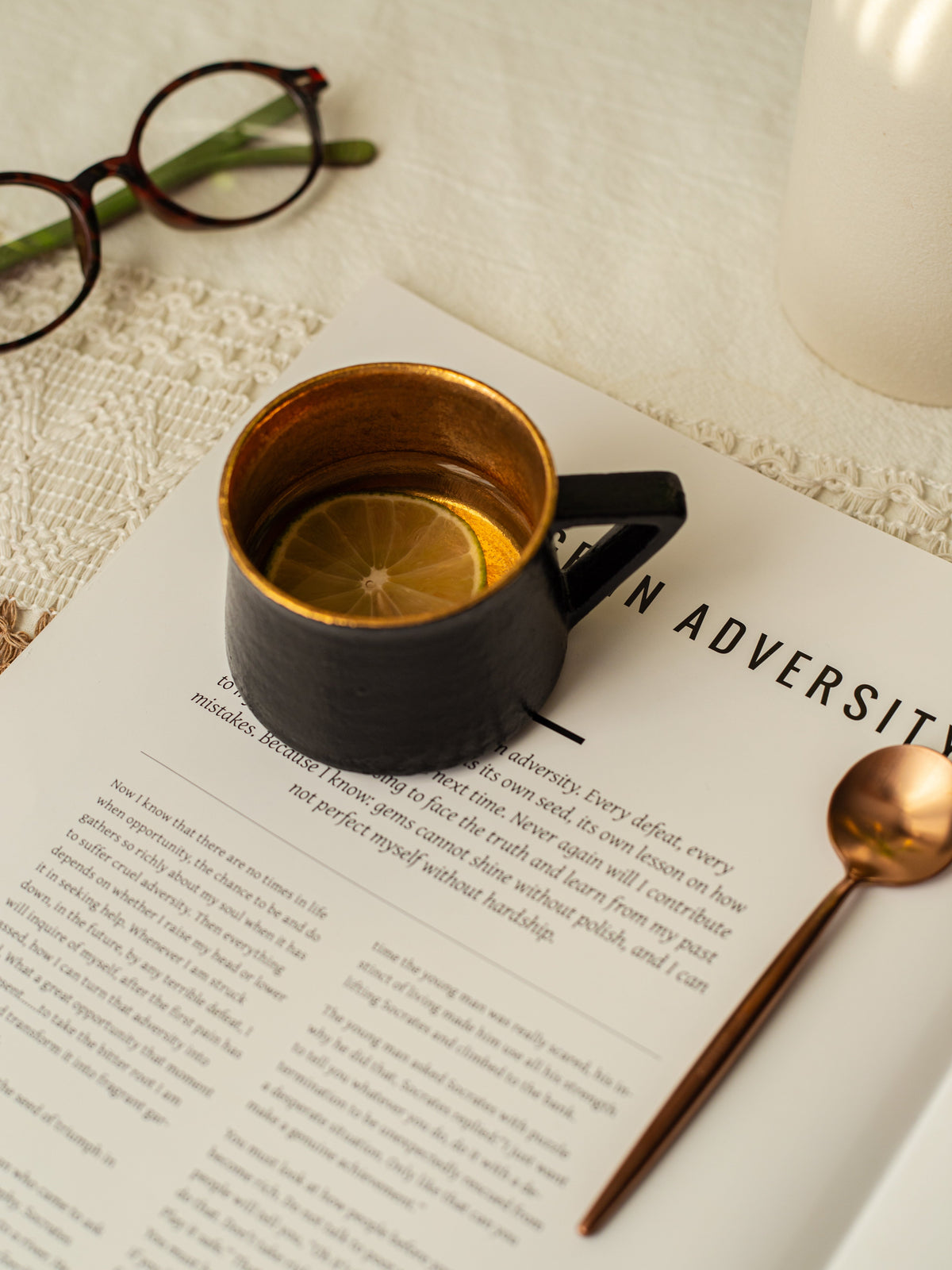
For the Blissful Reserve 24K Gold-Black Cup, the ceramic body is paired with Lu Bao Glaze, creating the distinctive dark surface of the cup.
The glaze is not simply an additional decorative layer. It contributes to the visual character of the finished piece and creates the surface against which the gold detailing is presented.
This illustrates an important principle when choosing ceramic espresso cups:
The quality of the finished object comes from the relationship between the ceramic body, glaze, form, and finishing—not from the material name alone.
Ceramic Craftsmanship Matters More Than the Label
When shopping for espresso cups, it is tempting to ask:
Ceramic or porcelain—which one is better?
A more useful question is:
How well has the material been turned into a finished cup?
Two cups made from the same broad material category can have completely different levels of quality.
Look for:
-
Consistent glaze application
-
Clean edges
-
Smooth interior surfaces
-
Balanced proportions
-
Well-finished rims
-
Secure handles
-
Even decorative details
-
Appropriate wall thickness
These details are especially noticeable on a small espresso cup.
There is simply less surface area to hide imperfections.
What About 24K Gold on Ceramic Espresso Cups?
Gold detailing introduces another layer of craftsmanship.
Gold can be applied to ceramic tableware as a decorative finish, creating a contrast between the ceramic surface and metallic detailing.
On the Blissful Reserve 24K Gold-Black Cup, 24K gold gilding is used on the interior, creating a distinctive contrast with the dark exterior.
The result is deliberately different from a plain white café-style espresso cup.
Rather than treating decoration as an afterthought, the gold detailing becomes part of the visual identity of the object.
Because gold decoration can require more careful handling, buyers should also pay attention to the manufacturer's care instructions.
Ceramic Espresso Cups and Heat Retention
One common misconception is that a particular material automatically guarantees better heat retention.
In reality, heat behavior is influenced by several factors.
These include:
-
Material composition
-
Cup mass
-
Wall thickness
-
Cup temperature before use
-
Espresso volume
-
Ambient temperature
-
Shape
A thick ceramic cup that has been preheated may behave very differently from a thin ceramic cup at room temperature.
The same principle applies to porcelain.
Therefore, when evaluating espresso cup materials, think about the complete construction rather than assuming that one material always performs better.
Which Is More Durable: Ceramic or Porcelain?
Durability depends on the specific material formulation and manufacturing process.
Porcelain can be hard and relatively resistant to scratching because of its highly fired, refined body.
Ceramic products can also be highly durable, particularly when properly manufactured and fired.
However, no fine ceramic or porcelain tableware should be considered indestructible.
Handles, thin rims, decorative finishes, and metallic detailing can require more care than a basic utilitarian mug.
For premium espresso cups, following the manufacturer's cleaning and handling recommendations is particularly important.
Which Looks More Luxurious?
This is primarily a matter of design rather than material.
Porcelain has a long association with fine tableware and can create an understated, elegant appearance.
Ceramic can range from simple and rustic to highly refined and decorative.
A luxury espresso cup can therefore be made from either.
Luxury may come from:
-
Material quality
-
Craftsmanship
-
Surface treatment
-
Hand-applied details
-
Proportion
-
Rarity
-
Design
A restrained porcelain cup can feel luxurious.
A richly glazed ceramic cup with hand-applied gold can feel luxurious in an entirely different way.
Ceramic or Porcelain: Which Should You Choose?
If you are choosing espresso cups for your home, use the following as a starting point.
Choose ceramic espresso cups if you want:
-
Greater variety in finishes and styles
-
A more substantial tactile experience
-
Decorative glazing
-
Handcrafted character
-
A distinctive statement piece
Choose porcelain espresso cups if you want:
-
A refined and clean appearance
-
Fine tableware aesthetics
-
Smooth surfaces
-
A more traditional formal setting
But there is no requirement to choose one exclusively.
The right cup is ultimately the one whose material, construction, capacity, craftsmanship, and appearance fit the way you drink and serve espresso.
A Ceramic Espresso Cup with Kaolin Clay, Lu Bao Glaze and 24K Gold
For those who prefer the character of a refined ceramic espresso cup, the Blissful Reserve 24K Gold-Black Cup brings several material and finishing elements together in a compact 2 oz format.
Its ceramic body incorporates kaolin clay, while Lu Bao Glaze creates the distinctive black surface. The interior is finished with 24K-gold gilding, adding a warm metallic contrast to the dark ceramic.
The result is not simply a small vessel for espresso.
It is an example of how material, glaze, craftsmanship, and finishing can work together to give a functional object a more distinctive presence.
At 2 oz, the cup is also appropriately compact for traditional espresso servings.
Explore the 24K Gold-Black Cup
Frequently Asked Questions
Are ceramic espresso cups better than porcelain?
Neither is universally better. Ceramic is a broad material category, while porcelain is a specialized type of ceramic. The quality of the individual cup depends on its construction, material formulation, thickness, craftsmanship, and finish.
Is porcelain a type of ceramic?
Yes. Porcelain is generally classified as a type of ceramic.
What is the best material for espresso cups?
Ceramic and porcelain are both excellent choices. The best material depends on your preferences for weight, thermal behavior, appearance, durability, craftsmanship, and design.
Are ceramic espresso cups good for heat retention?
They can be. Heat retention depends on the specific ceramic body, wall thickness, cup mass, starting temperature, and other design factors.
What are premium espresso cups made from?
Premium espresso cups can be made from ceramic, porcelain, bone china, and other materials. Premium quality depends on the material as well as craftsmanship, construction, and finishing.
Are 24K gold espresso cups practical?
24K gold detailing can create a distinctive and refined finish, but cups with metallic decoration may require more careful handling than undecorated tableware. Always follow the manufacturer's care instructions.
Final Thoughts
When comparing ceramic espresso cups and porcelain espresso cups, the most important distinction is that porcelain is itself a type of ceramic.
The real choice is not simply between two labels. It is about understanding the material body, glaze, thickness, construction, craftsmanship, and finish that make up the finished cup.
Ceramic offers exceptional versatility, while porcelain is valued for its refined surface and fine-tableware character. Neither automatically makes a better espresso cup.
For a more distinctive option, the Blissful Reserve 24K Gold-Black Cup demonstrates how kaolin clay, ceramic craftsmanship, Lu Bao Glaze, and 24K-gold detailing can come together in a compact espresso vessel.
Ultimately, the best espresso cup is one where the material and craftsmanship serve both the coffee and the experience of drinking it.