

A deep dive into craftsmanship, materials, and design philosophy — showing how thoughtful teaware shapes flavor, aroma, and atmosphere.
The leaf teaches the vessel
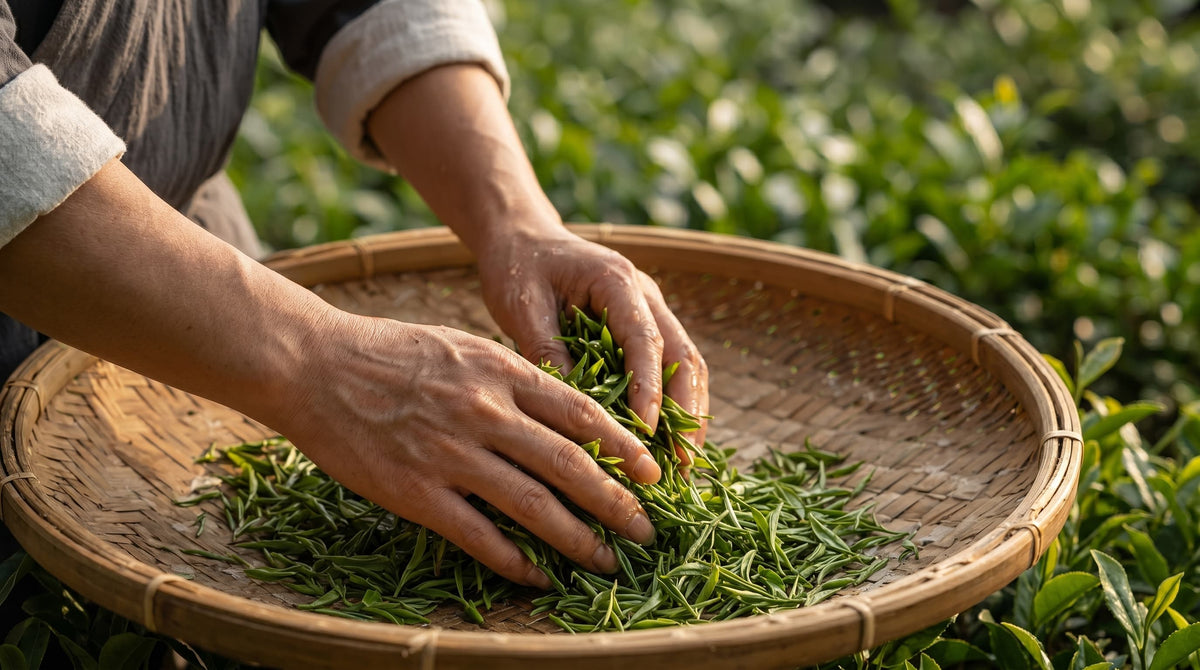
Look closely at the photo above. Those are not factory hands. They are sorting needle-fine spring buds, fingertip by fingertip, in a hand-woven bamboo tray, with the field still humming behind them. That attention — tactile, patient, human — is exactly what exceptional teaware carries forward. The leaf's journey doesn't end at harvest. It ends in your cup. And everything between — clay, fire, glaze, geometry — is a second craft that decides what you actually taste.
In the tea room we say: the pot is the last tea master. A thoughtful vessel doesn't decorate tea. It shapes it.
"Key Insight: Great tea farmers work by sense, not stopwatch. So do great potters. In China and Japan, teaware was never just utilitarian — it was an extension of the tea master’s intention, “an art form that invites mindfulness, respect, and appreciation.” Form follows leaf."
Three Traditions, One Question
| Tradition | Vessel | Philosophy |
|---|---|---|
| Chinese Gongfu | Gaiwan | Symbolizes heaven, earth, and human in one bowl |
| Yixing Heritage | Zisha Teapot | Built as a living history of brews — one tea, one pot |
| Japanese Chanoyu | Chawan | Embraces wabi-sabi — "finding beauty in imperfection, impermanence, and natural aging" [1] |
Each tradition answers the same question the hands in that bamboo tray are answering: how do we honor what the leaf already is?
“To drink from a Yixing pot or hold a gaiwan is to hold centuries of philosophical design in your palm.”
Craftsmanship: 72 Touches, One Perfect Pour
A true handmade teapot takes 3–5 days and more than 72 discrete steps — from aging zisha ore for months, to pounding, wedging, slab-building, spout-setting, and wood-firing. In Jingdezhen, our Qinghua blue-and-white studio still throws, paints, glazes and fires entirely by hand, with a success rate so low the pieces are made-to-order only.
Why Failure Rates Matter
| Material | Failure Rate | Why It Matters |
|---|---|---|
| Unglazed Porcelain | 30–50% | "The pots are melted in the kiln and come out looking like a candle rather than a teapot" [2] |
| Yixing Zisha | 20–30% | Wood-firing variables, clay consistency |
| Jian Zhan | 40–60% | Glaze crystallization is unpredictable |
That risk is why the good ones feel alive.
Ancient Mathematics, Modern UX
Ming and Qing teapots consistently follow Golden Ratio proportions — spout-to-handle balance, Shi Piao height-to-width — not for ornament, but so the pot:
- Feels balanced when lifted
- Pours without dripping at 35–45°
- Circulates water the way leaves want to open [2]
It's human-centered UX, 400 years before that term existed: "Master artisans would create teapots using proportions based on hand measurements… This human-centered mathematics created teaware that felt like natural extensions of the body." [2]
Materials Are Flavor Chemistry: A Scientific Breakdown
This is where we have to be honest: your teaware is a small chemical reactor. Thermal mass, porosity, and surface minerals actively modify extraction. Understanding this changes how you brew.
White Porcelain — The Honest Mirror
| Property | Value | Impact on Tea |
|---|---|---|
| Porosity | <0.5% | Zero adsorption, zero mineral contribution |
| Thermal Conductivity | 2–3 W/m·K | Moderate heat retention |
| Chemical Reactivity | Inert | Pure, unaltered expression |
"Pure, unaltered expression of the leaf — reveals both flaws and brilliance." [3]
Best for: Green tea, white tea, fragrant oolongs, tea evaluation/cupping
Why professionals choose it: It lies to no one. If the tea has flaws, porcelain exposes them. If it's brilliant, porcelain reveals every note.
Yixing Zisha — The Living Clay
| Property | Value | Impact on Tea |
|---|---|---|
| Porosity | Dual-pore (unglazed) | Adsorbs rough phenolics and warehouse notes |
| Thermal Conductivity | 0.6–1.0 W/m·K | High heat retention |
| Seasoning | Builds tea-oil patina | Smooths edges, deepens flavor over time |
"The porous clay will retain oils and aromas… mixing will muddy the flavor profile." [4]
Best for: Roasted oolong (Wuyi Yancha), aged pu-erh, black tea
Golden Rule: One tea, one pot — always.
Jian Zhan / Iron-Rich — The Sweetener
| Property | Value | Impact on Tea |
|---|---|---|
| Glaze Composition | Fe₂O₃ (iron oxide) rich | Binds tea polyphenols |
| Effect | Reduces astringency | Brain reads more amino acids and sugars |
| Result | Measurably rounder, sweeter cup |
Best for: Black tea, ripe pu-erh, dark oolongs
Science: The iron in the glaze interacts with tannins, perceptibly softening the cup.
Glass, Stoneware & Silver — Specialists
| Material | Thermal Profile | Best For | Unique Property |
|---|---|---|---|
| Glass | Neutral, fast-cooling | Blooming teas, delicate greens | Visual — watch leaves unfurl [5] |
| Tokoname Stoneware | Iron-rich clay | Japanese greens, daily drinkers | "Absorbs aromatics and tea oils… seasoned just like cast-iron pans" [6] |
| Silver | Ion purification | White tea, premium blacks | Highlights aromatics without interference [3] |
Side-by-Side: The Difference Is Visceral
"Pour the same Tie Guan Yin into a thin porcelain gaiwan and into a high-fired Zhu Ni Yixing teapot. In porcelain, the aroma will leap out — high, sharp, almost aggressive… In the Yixing teapot… the tea will feel rounder, silkier, and the aftertaste will linger longer." [4]
"Porcelain and glass do not absorb water, so the aroma and ingredients are hard to absorb, allowing the flavor and aroma of the tea to be served straight away. Pottery is highly absorbent, so the tea wares absorb excess components and astringency, and produce a clean mild taste." [7]
Quick Material Map: Which Teaware for Which Tea
Use this cheat sheet when building your gongfu tea setup:
| Tea Category | Recommended Vessel | Volume | Why |
|---|---|---|---|
| Green / White / Light Oolong | Jingdezhen porcelain gaiwan, thin-walled glass kyusu | 120–150ml | Keeps brightness true; visual clarity |
| Roasted Oolong / Dancong | 160ml Zisha or unglazed porcelain | 160ml | Rounds roast, deepens honey notes |
| Aged / Ripe Pu-erh | 180–200ml Duan Ni or Jian Shui clay | 180–200ml | Tames storage notes, builds body |
| Black Tea / Daily Drinking | Jian Zhan cup, glazed ceramic | 150–200ml | Sweetens tannin, holds heat well |
"Pro Tip: If you drink a little of everything, start honest: a 130ml white porcelain gaiwan. It is the control group of tea — unbreakably useful, and the same tool judges use at origin, right there beside the bamboo trays."
Design Philosophy: Atmosphere You Can Taste
Exceptional teaware choreographs all five senses. Here's how design choices translate to sensory experience:
Geometry & Ergonomics
| Design Element | Sensory Impact | Engineering Purpose |
|---|---|---|
| Wall thickness | Lip feel, cooling rate | Thicker = higher thermal mass, slower cooling; Thin rims = sensory precision [8] |
| Cup shape | Aroma delivery | Wide bowl = spreads aroma to nose; Tall aroma cup = concentrates it |
| Pot interior | Leaf expansion | Bowl-shaped = lets twisted leaves expand freely for "consistent extraction from each tea leaf" [6] |
| Spout angle | Pour control | 35–45° optimal for drip-free pour |
| Lid fit | Heat retention, aroma capture | Soft "thunk" = proper seal |
The Aging Journey: Sodateru (育てる)
The Japanese call the aging process sodateru — nurturing. This is wabi-sabi in practice:
- Unglazed clay: Absorbs tea oils, gradually "develops a seasoned interior that improves flavor extraction"
- Glazed bowls: Develop tea maps, fine crazing stained by years of use [1]
"Beauty that accrues, not fades."
Chinese Aesthetic Principles (Our Maker's Brief)
We still brief our makers with five words:
- 简 (Simplicity) — Clean lines, no superfluous detail
- 和 (Harmony) — Balanced shapes, proportional size
- 自然 (Naturalness) — Raw texture, honest materials
- 中庸 (Balance) — The middle way, neither extreme
- Chan-yi beauty — Rustic surfaces that accept time
""A teapot is not just a vessel. The material changes how long your water stays hot, whether the pot picks up flavor over time, and how careful you have to be when you wash it. Those three factors quietly shape every cup you pour." — Art of Tea [5]"
From Our Studio to Your Table: How to Choose
Decision Framework
What tea do you drink most?
- Everything / exploring → 130ml White Porcelain Gaiwan
- One tea deeply (roasted Wuyi, aged Liu Bao) → Dedicated Clay Pot
Care: Rinse with hot water only, never soap
After 20–30 sessions: taste the seasoning (smoother front, longer sweet tail)
- Mostly black tea / daily → Jian Zhan or glazed ceramic
Size Honestly
| Household | Pot Volume | Reasoning |
|---|---|---|
| 1–2 people | 12–16 oz (350–470ml) | Half-empty pot cools fast |
| Sharing / guests | 24 oz+ (700ml+) | Maintains temperature for multiple pours |
Quality Checklist (What We Look For)
- Spout pour: 7–9 seconds full, no dribble
- Lid seat: Soft "thunk" — not loose, not tight
- Handle heat: Stays cool after 30 seconds of steaming
- Balance: Feels like an extension of your hand
- Wall thickness: Consistent, no thin spots
- Clay/glaze integrity: No hairline cracks, even firing
FAQ: Your Teaware Questions Answered
Q: What's the difference between a gaiwan and a teapot for gongfu tea?
A: A gaiwan (lidded bowl) is more versatile — neutral porcelain works for any tea, easier to clean, and lets you watch leaves. A teapot (especially Yixing clay) actively interacts with tea, building seasoning over time. Beginners should start with a 100–150ml porcelain gaiwan; commit to a clay pot only when you've found a tea you drink daily.
Q: Can I use one Yixing teapot for different teas?
A: No. Yixing clay is porous and unglazed — it absorbs tea oils and aromas. Brewing a floral oolong in a pot seasoned with smoky pu-erh will muddy both flavors. One tea type per pot is the golden rule. If you switch teas daily, use porcelain or glazed ceramic instead.
Q: Why does tea taste different in a Jian Zhan cup vs. porcelain?
A: Jian Zhan (Tenmoku) cups have an iron-rich glaze (Fe₂O₃) that binds tea polyphenols, reducing astringency. Your brain perceives more amino acids and sugars, creating a measurably rounder, sweeter cup. Porcelain is chemically inert — it delivers the tea's true profile without modification.
Q: What size gaiwan should I buy for solo gongfu brewing?
A: 100–150ml is the sweet spot for solo sessions. Smaller (80ml) concentrates flavor but cools fast; larger (180ml+) requires more leaf and can over-extract for one person. A 130ml porcelain gaiwan is the most versatile starting point.
Q: How do I care for a Yixing teapot?
A:
- Before first use: Rinse, then boil in water for 20 minutes (optional: add tea of the type you'll brew)
- Daily: Rinse with hot water only — never soap
- After session: Leave lid off to air dry completely
- Seasoning: Develops naturally over 20–30 sessions; wipe exterior with tea cloth to build patina
Q: Is glass teaware good for gongfu tea?
A: Glass is excellent for green, white, and blooming teas — neutral flavor, visual beauty, fast cooling prevents over-extraction of delicate leaves. It's less ideal for oolongs and pu-erhs that benefit from heat retention. Avoid thermal shock: warm the glass first with hot water.
Q: What's a "fairness pitcher" (gong dao bei) and do I need one?
A: A fairness pitcher (cha hai / gong dao bei) decants tea from the brewing vessel before serving. It ensures every cup has identical strength — without it, the first cup is weak, the last is strong. Essential for gongfu tea; a small heat-proof glass pitcher works as a beginner substitute.
Q: How much tea leaf should I use for gongfu brewing?
A: General ratio: 5–7g per 100–120ml vessel.
- Rolled oolongs (Tie Guan Yin): 5–6g
- Loose large-leaf teas: 6–7g
- Compressed pu-erh: 7–8g (break gently)
- Adjust to taste — more leaf = shorter steeps, more infusions.
Q: Can I put my teaware in the dishwasher?
A:
- Porcelain/glazed ceramic: Generally yes (top rack, gentle cycle)
- Yixing / unglazed clay: Never — soap ruins seasoning
- Jian Zhan: Hand wash recommended to preserve glaze
- Silver: Hand wash only, dry immediately to prevent tarnish
- Glass: Dishwasher safe but hand washing prevents etching
The Last Tea Master
Back in the field, those hands are choosing which buds become your tea. In your kitchen, your hands choose the vessel that finishes the story. The right teaware doesn't add noise. It removes it — heat held steady, harshness adsorbed, aroma lifted at the perfect angle, weight balanced in your palm.
That's the artistry behind exceptional teaware: material science in service of quiet. Function so considered it becomes feeling. A simple object carrying the soul of a civilization — and the memory of the hands that sorted the leaf, one tender bud at a time.
"From leaf to cup. Brew with intention."
