


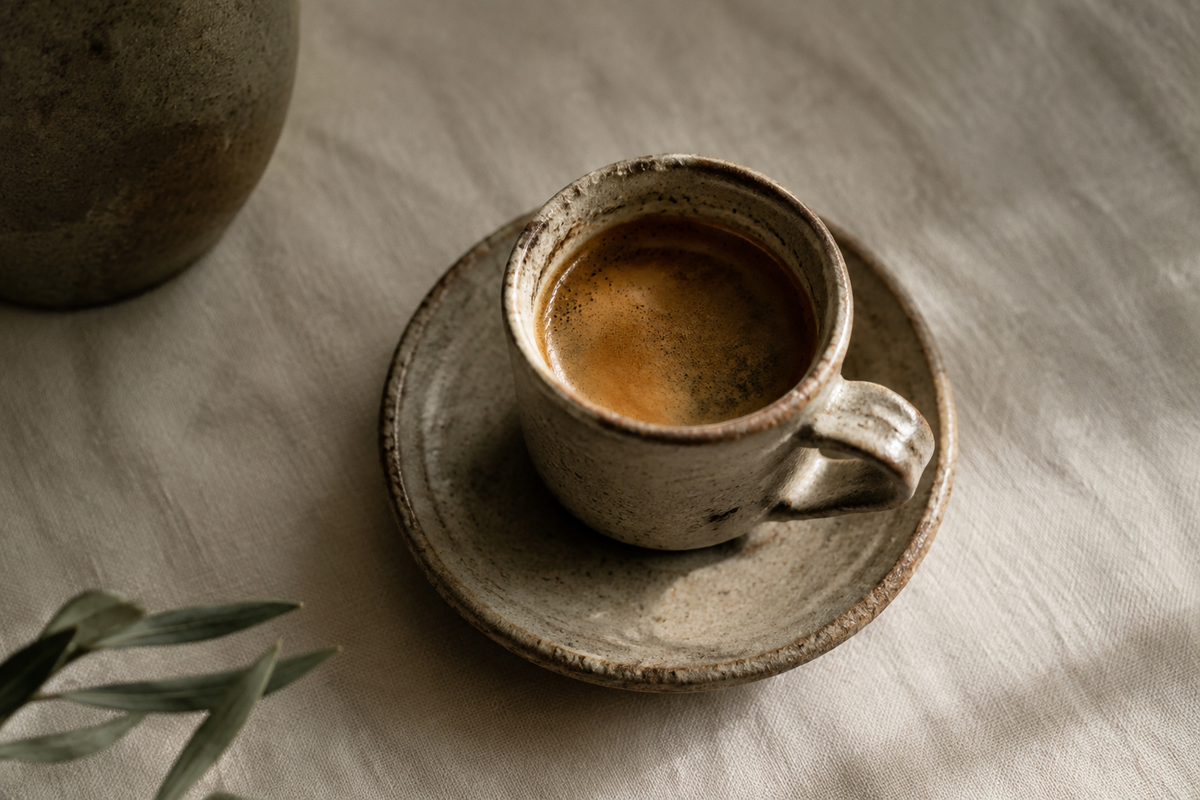
A high-quality ceramic espresso cup is defined by more than its appearance.
Two cups can both be described as ceramic espresso cups, yet differ considerably in weight, surface quality, durability, proportions, and overall feel. The difference often begins long before the finished cup reaches the table.
The quality of a ceramic espresso cup is influenced by the entire production process—from the clay body and firing temperature to the glaze, wall thickness, shaping, and final finishing.
For anyone looking for high quality espresso cups or premium ceramic cups for the home, understanding these stages makes it easier to recognize quality beyond a product photograph.
1. It Starts With the Clay
The foundation of a ceramic cup is its clay body.
Different ceramic bodies produce different characteristics after firing. The composition of the clay affects the finished cup's density, color, texture, strength, and suitability for particular forms and finishes.
For refined ceramic tableware, kaolin clay is one material worth understanding. Kaolin is a relatively pure clay associated with fine ceramic and porcelain production because of its mineral composition and behavior during firing.
However, the presence of a particular clay does not automatically make a cup high quality.
The quality of the raw material, preparation of the clay, forming process, firing conditions, and finishing all contribute to the final result.
In other words:
Good clay provides the foundation, but craftsmanship determines how that foundation becomes a finished cup.
2. Firing Determines the Ceramic Body
After the cup has been formed, firing transforms the clay into a durable ceramic body.
During firing, the ceramic undergoes physical and chemical changes as temperatures rise. The exact firing schedule depends on the type of ceramic body and glaze being used.
Firing affects characteristics such as:
-
Density
-
Strength
-
Porosity
-
Dimensional stability
-
Surface characteristics
-
Interaction between the clay body and glaze
Consistent firing is particularly important for premium ceramic tableware. If firing conditions vary too much, the finished pieces can develop differences in shape, color, surface quality, or structural integrity.
For this reason, a high-quality ceramic cup is not simply shaped and decorated. It is the result of a controlled process in which the ceramic body is developed to perform consistently after firing.
3. Glaze Creates More Than a Surface Color
Glaze is often the most immediately visible part of a ceramic cup, but its role goes beyond appearance.
A ceramic glaze is a glass-like coating that melts and develops during firing, creating the finished surface of the piece.
The glaze can influence:
-
Color
-
Gloss or matte appearance
-
Texture
-
Visual depth
-
Surface smoothness
-
Stain resistance
-
The way light interacts with the cup
This is why two ceramic espresso cups made from similar clay can look completely different.
A carefully developed glaze can give a cup a subtle depth that cannot be achieved simply by applying a flat color.
Lu Bao Glaze and Ceramic Craftsmanship
The Blissful Reserve 24K Gold-Black Cup uses Lu Bao Glaze to create its distinctive black surface.
The glaze works with the ceramic body rather than simply covering it with an ordinary painted finish. The result is a dark, refined surface that provides contrast with the gilded interior.
This is an example of why glaze should be considered part of ceramic craftsmanship rather than merely a decorative afterthought.
4. Wall Thickness Matters
The thickness of a ceramic espresso cup affects both its physical character and how it behaves during use.
A cup that is extremely thin may feel delicate and lightweight, while a thicker ceramic wall can create a more substantial feeling in the hand.
Thickness can also influence thermal behavior.
When hot espresso enters a cup, some heat is transferred from the coffee into the cup itself. The amount and speed of that transfer depend on several factors, including the material, wall thickness, mass of the cup, starting temperature of the cup, and environmental conditions.
This means there is no universally ideal wall thickness.
Instead, a well-designed espresso cup balances:
strength + comfort + proportions + thermal behavior
For a small 2 oz espresso cup, these proportions become particularly noticeable because the cup itself is physically close to the scale of the beverage.
5. Shape Requires Precision
A high-quality ceramic espresso cup should have consistent proportions.
Look closely at:
-
The circularity of the opening
-
The symmetry of the body
-
The relationship between height and diameter
-
The shape of the base
-
The angle of the walls
-
The handle attachment, if applicable
-
The consistency between pieces in a set
Small irregularities may be part of the character of genuinely handcrafted ceramics, but uncontrolled variation is different from intentional craftsmanship.
A well-made cup should feel considered rather than accidental.
6. The Rim Is a Small Detail With a Big Impact
The rim is one of the parts of an espresso cup you interact with most directly.
A carefully finished rim should be smooth and comfortable against the lips, without rough edges or obvious irregularities.
The thickness of the rim also contributes to the overall drinking experience.
Some espresso drinkers prefer a fine rim that feels delicate and precise, while others prefer a slightly more substantial edge.
There is no universal standard, but poor finishing is easy to notice.
For premium espresso cups, details such as the rim are often where manufacturing quality becomes tangible.
7. Craftsmanship Shows in the Details
The word "premium" can be used very loosely in tableware.
A genuinely well-made ceramic cup should show consistency in areas that may not be obvious in a product photograph.
Look for:
-
Even glazing
-
Clean transitions between surfaces
-
Smooth rims
-
Stable bases
-
Consistent dimensions
-
Carefully finished handles
-
Controlled decorative details
-
Minimal visible manufacturing defects
For handmade or artisan pieces, some variation may be intentional. What matters is whether the variation contributes to the character of the piece rather than indicating poor control of the manufacturing process.
Craftsmanship is ultimately about how well the different stages of production work together.
8. The Finish Should Match the Material
A good finish should complement the underlying ceramic rather than overwhelm it.
This is particularly important for premium ceramic cups.
A refined finish can emphasize:
-
The natural form of the cup
-
The depth of the glaze
-
The contrast between surfaces
-
The quality of the ceramic body
-
Decorative details
-
The proportions of the piece
For example, a dark glazed ceramic body can create a strong visual foundation for metallic detailing.
This is one reason restrained finishes can sometimes feel more sophisticated than excessive decoration.
9. Gold Detailing Requires Another Layer of Craftsmanship
Some premium ceramic espresso cups incorporate metallic detailing, such as gold.
Gold decoration is not simply another type of glaze. It requires an additional finishing process and careful application.
On a piece such as the Blissful Reserve 24K Gold-Black Cup, the interior is finished with 24K-gold gilding, creating a strong contrast with the black ceramic exterior.
The combination is visually distinctive, but the important point is that the metallic finish is integrated into the overall design rather than treated as an isolated decorative element.
For buyers interested in premium espresso cups, details such as gilding can therefore be considered alongside the underlying ceramic craftsmanship.
10. Quality Is the Result of the Entire Process
It is tempting to identify one feature as the definition of a high-quality ceramic cup.
It might be:
-
The type of clay
-
The firing temperature
-
The glaze
-
The thickness
-
The craftsmanship
-
The decorative finish
But none of these factors exists independently.
A high-quality ceramic espresso cup is the result of the relationship between them.
Clay provides the foundation.
Firing develops the ceramic body.
Glaze creates and protects the surface.
Thickness influences structure and thermal behavior.
Craftsmanship controls the form.
Finishing gives the piece its final character.
That is what makes ceramic quality difficult to judge from a specification sheet alone.
Ceramic vs. Porcelain: Does the Material Name Tell You Everything?
Not necessarily.
Porcelain is a type of ceramic, and the distinction between ceramic and porcelain is more nuanced than simply labeling one material "better."
Porcelain is generally associated with specific clay compositions and firing characteristics, while the broader category of ceramics includes many different clay bodies and production methods.
For an espresso cup, the material name is only one part of the equation.
The actual construction, wall thickness, firing, glaze, proportions, and craftsmanship can have a significant influence on the finished product.
This is why a well-made ceramic espresso cup can be an excellent choice even when it is not marketed specifically as porcelain.
What Should You Look for in High-Quality Ceramic Espresso Cups?
If you are comparing premium espresso cups, consider the following checklist:
| Feature | What to look for |
|---|---|
| Clay body | Appropriate, well-prepared ceramic material |
| Firing | Consistent and suitable for the ceramic body and glaze |
| Glaze | Even, intentional, and well-finished surface |
| Thickness | Balanced for strength, comfort, and use |
| Shape | Consistent and well-proportioned |
| Rim | Smooth and comfortable |
| Base | Stable and evenly finished |
| Craftsmanship | Controlled details and minimal defects |
| Decorative finish | Carefully integrated rather than superficial |
| Overall design | Material, function, and aesthetics working together |
No single specification guarantees quality. The goal is to evaluate the cup as a complete object.
A Refined Example: The 24K Gold-Black Cup
The Blissful Reserve 24K Gold-Black Cup illustrates how several of these elements can come together in one espresso cup.
Its ceramic body incorporates kaolin clay, while Lu Bao Glaze creates the distinctive black exterior. The interior is finished with 24K-gold gilding, adding a refined metallic contrast to the dark ceramic surface.
At 2 oz, the cup is intentionally compact for espresso rather than designed as a general-purpose coffee mug.
The result is a ceramic espresso cup where material, proportion, surface treatment, and decorative finishing are considered as part of the same design.
For those looking for high quality espresso cups with a more distinctive presentation, it offers an alternative to plain commercial espresso cups while retaining the compact proportions expected of traditional espresso service.
Frequently Asked Questions
What makes a ceramic espresso cup high quality?
Quality comes from the combination of the ceramic body, firing, glaze, wall thickness, shaping, craftsmanship, and final finishing. No single material or specification determines quality on its own.
Are ceramic espresso cups better than porcelain?
Neither is universally better. Porcelain is a type of ceramic, and the performance and appearance of an espresso cup depend on its specific construction, thickness, firing, glaze, and craftsmanship.
Does thicker ceramic make a better espresso cup?
Not necessarily. Thickness affects weight, strength, and thermal behavior, but an ideal espresso cup needs a balance between these characteristics rather than simply being as thick as possible.
Is kaolin clay good for ceramic cups?
Kaolin is widely used in fine ceramic and porcelain production. Its suitability for a particular cup depends on the formulation of the ceramic body and the production process.
What does glaze do on a ceramic espresso cup?
Glaze creates the finished surface of the ceramic, influencing its appearance, texture, smoothness, and other surface characteristics.
Are premium espresso cups worth considering for home use?
If presentation, craftsmanship, and tactile experience matter to you, a more carefully made espresso cup can add a noticeable element to a home coffee ritual. The value ultimately depends on how much importance you place on those qualities.
Final Takeaway
A high-quality ceramic espresso cup is not defined by a single material, finish, or marketing label.
Its quality develops through a chain of decisions: clay, firing, glaze, thickness, shaping, craftsmanship, and finishing.
When these elements are carefully considered together, a small espresso cup becomes more than a vessel for coffee. It becomes part of the experience of preparing, serving, and enjoying it.
For traditional espresso, a 2 oz ceramic espresso cup can provide an appropriately compact proportion. For those who also value refined materials and distinctive craftsmanship, details such as kaolin clay, specialized glazing, and 24K-gold finishing offer another level of visual and tactile character.