


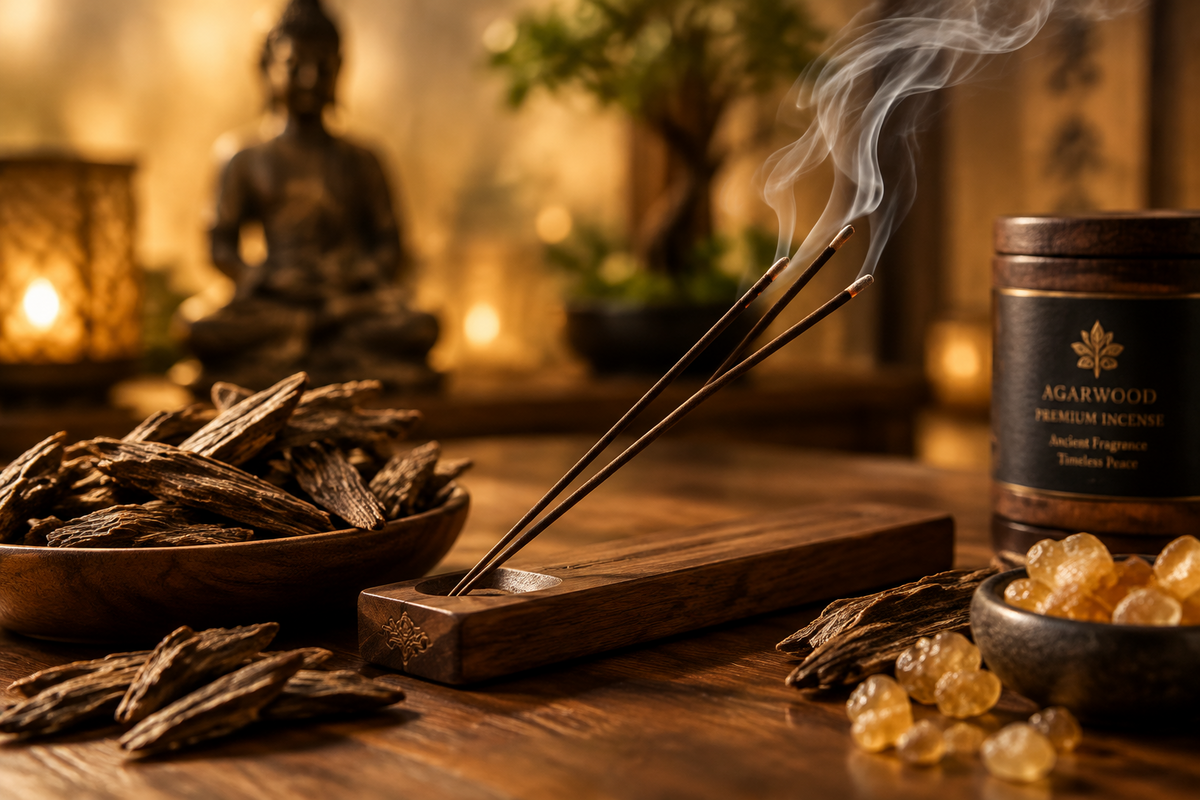
Agarwood incense sticks are incense sticks made with agarwood or agarwood-derived aromatic material, the resinous wood formed in certain Aquilaria trees. They are valued for their complex woody, resinous, earthy, sweet, floral, or balsamic fragrance.
Unlike ordinary wood, agarwood develops its characteristic aroma through the formation of aromatic resin within the tree. The resulting material can be used in incense, perfumery, and other fragrance traditions.
When choosing agarwood incense sticks, it is useful to look beyond the word “agarwood” on the label. The most important factors include what form of agarwood is used, whether synthetic fragrance is added, the origin of the material, the binder or formulation, scent profile, burn time, and how much smoke the incense produces.
What Are Agarwood Incense Sticks?
Agarwood incense sticks are incense sticks made with agarwood or agarwood-derived material from Aquilaria trees.
Agarwood itself is not a separate tree species. It is resinous aromatic wood that forms inside certain Aquilaria trees when the tree responds to injury, stress, or microbial activity.
The basic relationship is:
Aquilaria tree → resin formation → agarwood → aromatic material → incense
Agarwood incense can be produced in different forms, including:
-
Agarwood chips
-
Agarwood powder
-
Agarwood incense sticks
-
Agarwood cones
-
Blended incense formulations
-
Agarwood-based fragrance products
The term agarwood incense stick therefore describes the physical format, while the actual formulation can vary significantly between products.
Some incense sticks contain substantial amounts of agarwood material, while others may use a smaller quantity of agarwood alongside other aromatic materials or fragrance compounds.
This is why “agarwood incense” does not automatically describe one standardized product.
How Are Agarwood Incense Sticks Made?

The exact manufacturing process varies by producer, but a typical agarwood incense stick may involve several stages.
1. Selecting the Agarwood Material
Agarwood may be processed into smaller pieces or powder before being incorporated into incense.
The quality and aromatic character of the raw material depend on factors such as:
-
Aquilaria species
-
Geographic origin
-
Resin concentration
-
Resin distribution
-
Cultivation or natural formation
-
Processing
2. Preparing the Incense Material
The agarwood material may be ground or otherwise prepared into a form suitable for incense production.
Other ingredients can be introduced depending on the formulation.
These may include:
-
Natural binders
-
Other aromatic woods
-
Plant-based ingredients
-
Fragrance materials
The exact formulation determines how much the final incense reflects the character of the underlying agarwood.
3. Forming the Sticks
The prepared material is formed into long, narrow incense sticks.
Some formulations are made entirely from a combustible incense mixture, while others may use a supporting bamboo core.
For a consumer, the distinction is worth checking because “agarwood incense stick” does not necessarily mean a stick made exclusively from agarwood.
4. Drying
Freshly formed incense generally needs to dry under controlled conditions.
Drying affects:
-
Moisture content
-
Burn behavior
-
Structural stability
-
Fragrance release
The exact drying process varies according to the formulation and manufacturer.
5. Final Quality Control
Finished incense may be checked for dimensions, appearance, burn characteristics, fragrance, and packaging before being sold.
The final result is influenced by the entire formulation—not just the geographic origin of the agarwood.
What Do Agarwood Incense Sticks Smell Like?

Agarwood incense does not have one universal scent.
Depending on the raw material and formulation, agarwood incense can express:
-
Woody notes
-
Resinous depth
-
Earthy nuances
-
Warm balsamic qualities
-
Subtle sweetness
-
Floral facets
-
Musky characteristics
-
Soft smoky notes during burning
This complexity is one of the defining characteristics of agarwood as an aromatic material.
Why Does Agarwood Smell Different From Ordinary Wood?
Ordinary wood is primarily valued as a structural material.
Agarwood contains aromatic resin produced inside the tree. This resin contributes much of the distinctive fragrance associated with the material.
The result can be considerably deeper and more complex than the scent of untreated wood.
However, the precise aroma depends on the individual material.
Two agarwood incense sticks from different origins or formulations may smell substantially different even though both are labeled “agarwood.”
Agarwood and Oud
Agarwood is closely associated with oud, particularly in Middle Eastern and luxury perfumery.
Agarwood refers to the resinous aromatic wood itself.
Oud commonly refers to aromatic oil, material, or fragrance derived from agarwood.
Therefore:
Agarwood ≠ oud in every context
but:
Agarwood → source material associated with oud
This is why products may use descriptions such as agarwood oud incense or agarwood oud incense stick.
The terminology can vary between incense, perfumery, and retail contexts.
How Long Do Agarwood Incense Sticks Burn?
Burn time varies considerably according to the length, diameter, density, formulation, and airflow around the incense.
Typical burn times can range from approximately 20 minutes to more than an hour.
Longer sticks generally burn for longer, but length alone does not determine burn time.
Other factors include:
-
Stick density
-
Moisture content
-
Binder composition
-
Diameter
-
Airflow
-
Humidity
-
How the incense is manufactured
For this reason, it is better to use a manufacturer's stated burn time rather than assuming that all agarwood incense sticks burn at the same rate.
How Long Do Blissful Reserve Agarwood Incense Sticks Burn?
Blissful Reserve's Laos Red Earth Agarwood Supreme Incense Sticks are approximately 21 cm long and have an estimated burn time of 40–45 minutes per stick.
The package contains approximately 120 sticks / 19 g, with a stated total burn time of approximately 80 hours.
Actual burn time can vary depending on airflow and environmental conditions.
This makes one stick suitable for a relatively contained home ritual rather than requiring a very long incense session.
Natural Agarwood vs Fragrance-Based Incense
One of the most useful distinctions when choosing agarwood incense is whether the fragrance primarily comes from natural agarwood material or from added fragrance compounds.
The two approaches are not necessarily equivalent.
| Attribute | Natural Agarwood-Based Incense | Fragrance-Based Incense |
|---|---|---|
| Primary aromatic source | Agarwood or agarwood-derived material | Added fragrance materials |
| Scent character | Often complex and variable | Can be more standardized |
| Geographic origin | May be specified | May be less relevant |
| Batch variation | Can occur | Often more consistent |
| Aroma development | Can evolve during burning | Depends on fragrance formulation |
| Product labeling | May identify agarwood origin/content | May emphasize fragrance profile |
The distinction is particularly important for consumers searching for natural agarwood incense.
A product labeled “agarwood” may still contain other aromatic ingredients or fragrance materials, so checking the ingredient or composition information is useful.
What Does “Natural Agarwood Incense” Mean?
The phrase generally suggests that natural agarwood is an important aromatic component of the incense.
However, “natural” can be used differently by different manufacturers.
If the distinction matters to you, look for specific information about:
-
Agarwood content
-
Other ingredients
-
Synthetic fragrance
-
Artificial perfume
-
Dyes
-
Binders
-
Geographic origin
More detailed disclosure makes it easier to understand what you are actually purchasing.
How to Choose Agarwood Incense Sticks
When choosing agarwood stick incense, consider six practical factors.
1. Agarwood Origin
Origin can provide useful information about the raw material.
For example, incense made with Laos agarwood has a different geographic identity from incense using Vietnamese, Thai, Indonesian, or Malaysian agarwood.
Origin does not automatically determine quality, but it can help you understand the material.
2. Scent Profile
Consider the type of aroma you want.
Agarwood incense can range from:
-
Deep and resinous
-
Woody and earthy
-
Sweet and balsamic
-
Floral and soft
-
Musky
-
More noticeably smoky
If you prefer a quieter home fragrance, look for descriptions that emphasize the underlying wood and resin rather than heavy perfume.
3. Ingredient Transparency
Look for clear information about what the incense contains.
Useful questions include:
-
Is agarwood actually used?
-
Is the agarwood origin identified?
-
Are synthetic fragrances added?
-
Are dyes used?
-
What type of binder is used?
A transparent product description makes comparison much easier.
4. Burn Time
Choose a length and burn time that match your routine.
A 20-minute incense stick can work for a short pause, while a 40–60 minute stick may suit a longer tea, reading, meditation, or evening ritual.
5. Smoke Level
Agarwood incense still involves combustion, so some smoke is expected.
If you prefer a more restrained indoor experience, look for products specifically formulated for lower smoke output.
Ventilation is still appropriate whenever burning incense indoors.
6. Intended Use
Consider when you expect to burn it.
Agarwood incense can be used for:
-
Quiet evening rituals
-
Tea preparation
-
Reading
-
Meditation
-
Personal reflection
-
Home fragrance
-
Creating a defined atmosphere
The right choice depends more on the atmosphere and sensory experience you want than on a universal ranking of incense.
How to Burn Agarwood Incense at Home
Agarwood stick incense is relatively simple to use, but it should always be burned with care.
Step 1: Choose a Stable Incense Holder
Place the incense in a holder designed to catch ash.
The holder should sit on a stable, heat-resistant surface away from curtains, paper, furniture, and other combustible materials.
Step 2: Light the Tip
Light the end of the incense stick until it catches.
Allow a small glowing ember to form.
Step 3: Extinguish the Flame
Gently extinguish the visible flame while leaving the ember burning.
The incense should then begin releasing fragrance as it slowly smolders.
Step 4: Allow Airflow
Good ventilation is important when burning incense indoors.
Avoid placing incense directly beneath a strong fan or in an area where airflow could spread ash unpredictably.
Step 5: Never Leave Burning Incense Unattended
As with any burning material, incense should not be left unattended.
Extinguish it completely if you need to leave the room.
How Much Agarwood Incense Should You Burn?
More incense does not necessarily create a better aromatic experience.
For a smaller room, one stick may be sufficient.
If the fragrance becomes too strong or smoke accumulates, extinguish the incense and ventilate the room.
The goal is a controlled sensory experience rather than maximum fragrance intensity.
Agarwood Incense Sticks vs Agarwood Chips
Agarwood incense sticks are not the only way to experience agarwood.
| Format | Experience | Convenience |
|---|---|---|
| Agarwood incense sticks | Controlled, continuous burn | High |
| Agarwood chips | More direct interaction with raw material | Lower |
| Agarwood powder incense | Can be used in different incense formats | Moderate |
| Oud oil | Fragrance without burning wood | Different sensory format |
For someone new to agarwood, incense sticks are often a straightforward way to incorporate the material into an everyday ritual.
Chips and other raw forms offer a different experience because the user can explore the material itself rather than a finished incense formulation.
Agarwood Incense Sticks and Home Rituals
Agarwood incense has historically been associated with religious, cultural, and contemplative practices across different regions.
In a contemporary home, it can also function simply as a sensory ritual.
The appeal does not need to depend on a claim that incense produces a particular medical or psychological effect.
The experience can be as simple as:
light the incense → notice the first aroma → allow the fragrance to develop → finish the ritual when the stick burns down
This makes agarwood particularly compatible with quiet activities such as tea, reading, journaling, or an unhurried evening at home.
The ritual is less about filling a room with intense fragrance and more about creating a defined sensory moment.
Explore Laos Red Earth Agarwood Incense Sticks

For those specifically looking for Laos agarwood incense, Blissful Reserve's Laos Red Earth Agarwood Supreme Incense Sticks bring together Laos-origin agarwood, a restrained fragrance profile, and a contemporary home ritual.
The incense is described as 100% natural, with no synthetic additives, dyes, or artificial perfumes. Its fragrance combines woody, floral, and musky-honey characteristics, with an estimated 40–45 minute burn time per stick.
The formulation is designed around a lower-smoke experience, making it suitable for a considered indoor ritual while still requiring normal ventilation and safe burning practices.
Explore Laos Red Earth Agarwood Incense Sticks →
Frequently Asked Questions About Agarwood Incense Sticks
What are agarwood incense sticks?
Agarwood incense sticks are incense sticks made with agarwood or agarwood-derived aromatic material from certain Aquilaria trees. Their fragrance can include woody, resinous, earthy, sweet, floral, and balsamic characteristics.
What is agarwood stick incense?
Agarwood stick incense is another term for incense sticks formulated with agarwood material. The exact composition varies by manufacturer and may include binders, other aromatic woods, or additional fragrance materials.
Are agarwood incense sticks natural?
Some are made primarily with natural agarwood and other natural ingredients, while others may contain fragrance compounds or other additives. Check the manufacturer's composition information rather than assuming that every product labeled “agarwood” is fully natural.
What is natural agarwood incense?
Natural agarwood incense generally refers to incense in which natural agarwood is used as an important aromatic material. The precise meaning of “natural” depends on the manufacturer's formulation and labeling.
Do agarwood incense sticks smell like oud?
They can share aromatic characteristics because oud is commonly derived from agarwood. However, agarwood incense and oud fragrance are different formats and can smell quite different depending on the material and formulation.
How long do agarwood incense sticks burn?
Burn time varies by size and formulation. Many sticks burn for roughly 20–60 minutes, although some are shorter or longer. Blissful Reserve's Laos Red Earth Agarwood Supreme Incense Sticks are designed to burn for approximately 40–45 minutes per stick.
Are agarwood incense sticks smoky?
Burning incense produces some smoke, but smoke levels vary considerably between formulations. Products designed for lower smoke can provide a more restrained indoor experience, although ventilation remains appropriate.
How should agarwood incense sticks be stored?
Keep incense in a dry, cool place away from excessive humidity, direct sunlight, and strong competing odors. A sealed or well-protected container can help preserve the fragrance.
Can agarwood incense be used every day?
It can be incorporated into a regular home ritual if used responsibly. Burn it in a suitable holder, maintain ventilation, follow the manufacturer's instructions, and never leave burning incense unattended.