


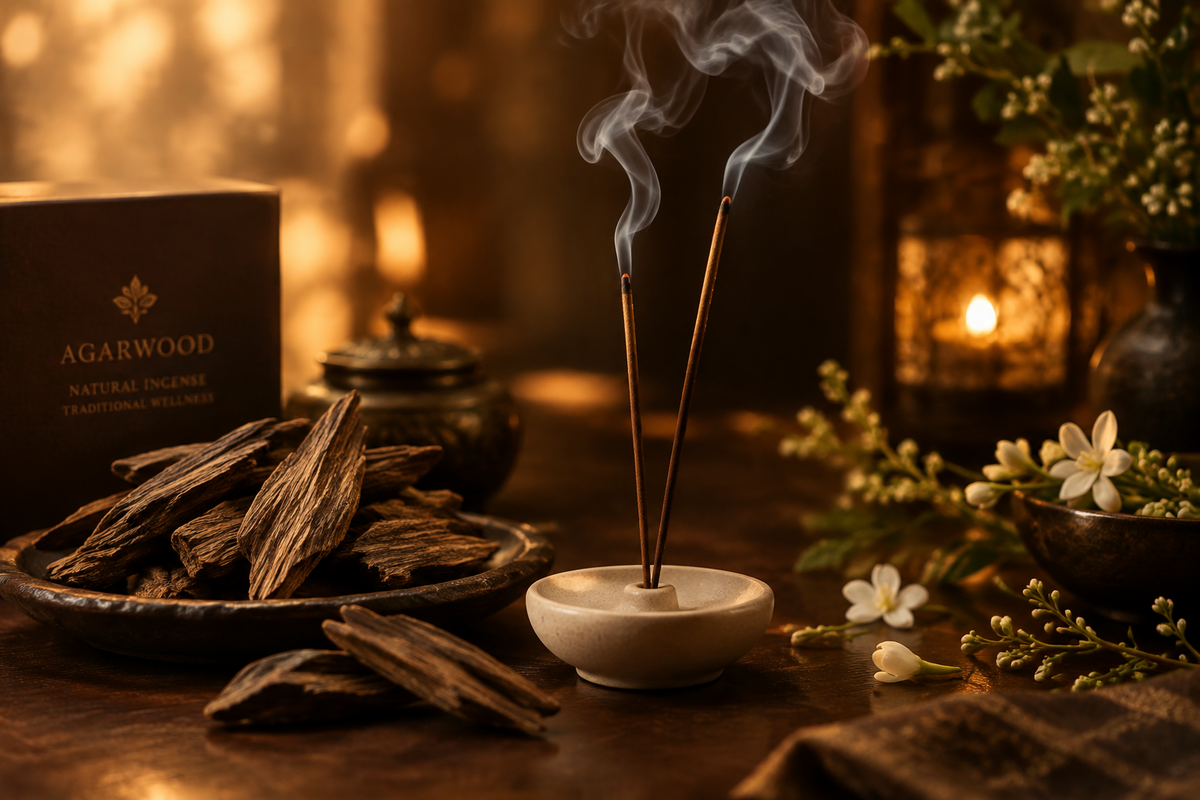
Agarwood incense is valued for its distinctive fragrance and its long association with ritual, contemplation, hospitality, and traditional cultural practices. The potential benefits of agarwood incense are therefore best understood in terms of sensory experience, atmosphere, and personal ritual rather than as medical treatments.
Agarwood has a deep, resinous aroma that can include woody, earthy, balsamic, warm, sweet, and smoky characteristics. When used as incense, this fragrance can become part of a slower daily ritual or help create a particular atmosphere within a space.
There is also a long history of traditional agarwood use across parts of Asia and the Middle East. However, traditional use should not automatically be interpreted as scientific evidence of a medical benefit.
What Are the Benefits of Agarwood Incense?

The benefits of agarwood incense are primarily sensory, atmospheric, and ritual-based.
People may choose agarwood incense because they appreciate:
-
Its complex woody and resinous fragrance
-
The gradual development of aroma while burning
-
Its ability to create a distinctive atmosphere
-
Its association with meditation and contemplative practices
-
Its role in personal or cultural rituals
-
The sensory transition it can create between different parts of the day
-
Its long-standing place in traditional incense culture
These are experiential benefits rather than medical claims.
For example, someone may burn agarwood incense before reading, drinking tea, meditating, or simply spending a quiet evening at home. The value comes from the experience and ritual surrounding the fragrance.
It is useful to distinguish this from claims that incense can treat anxiety, depression, insomnia, or other medical conditions. Such claims require specific clinical evidence and should not be assumed simply because agarwood has been traditionally used in contemplative settings.
Agarwood Incense for Sensory Rituals
One of the most accessible uses of agarwood incense is as part of a sensory ritual.
A sensory ritual is an intentional activity built around sight, smell, touch, taste, or sound. Incense naturally engages the sense of smell while also creating a visible and temporal element through the slow release of fragrance.
A simple agarwood ritual might involve:
-
Preparing a quiet space.
-
Lighting or heating the incense according to its instructions.
-
Allowing the first fragrance to develop gradually.
-
Taking time to notice the changing aroma.
-
Pairing the incense with another quiet activity, such as tea, reading, journaling, or contemplation.
The purpose is not to achieve a particular medical outcome.
Instead, the ritual creates a deliberate pause within the day.
This is particularly relevant to the way agarwood incense has traditionally been experienced: not simply as an air freshener, but as part of an intentional relationship with fragrance, time, and surroundings.
Agarwood Incense for Meditation and Quiet Practices

Agarwood has a long association with meditation, contemplation, religious practices, and other quiet rituals in different cultural traditions.
Its fragrance can become an environmental cue for a particular activity.
For example, someone may use the same incense when beginning a meditation session or another quiet practice. Over time, the fragrance can become associated with that routine.
This does not mean that agarwood incense itself has been established as a treatment for stress or a medical condition.
Rather, incense can be one component of a broader ritual environment.
The experience may involve several elements:
fragrance + quiet surroundings + deliberate breathing + reduced distractions + repeated ritual
The overall experience is therefore larger than the incense itself.
For meditation, the most appropriate way to think about agarwood is as a sensory element within a contemplative practice, rather than as a substance with a proven therapeutic effect.
Traditional Uses of Agarwood
Agarwood has a long history of traditional use across parts of South and Southeast Asia, South Asia, and the Middle East.
Historically, agarwood and its aromatic derivatives have been associated with:
Incense
Agarwood has been valued as a fragrant incense material because resin-rich wood releases a distinctive aroma when heated.
Religious and Ceremonial Practices
Agarwood and related aromatic materials have been used in various religious and ceremonial contexts. The specific practices and meanings differ considerably between cultures and traditions.
Hospitality
In some cultural traditions, fragrant materials including agarwood have been used to welcome guests or scent indoor spaces.
Perfumery
Agarwood-derived aromatic materials have also been used in traditional perfumery. The term oud is particularly associated with agarwood-derived fragrance materials and oils.
Personal and Domestic Rituals
The use of fragrant wood and incense can also form part of everyday domestic routines, including moments of reflection, tea drinking, or preparation for rest.
These historical uses demonstrate the cultural importance of agarwood, but they should not be confused with modern clinical evidence.
A traditional practice can be meaningful without necessarily proving that the material has a specific therapeutic effect.
Why Aroma Can Influence the Atmosphere of a Space
Scent has an unusual ability to change how a space is perceived.
Unlike an object that remains visually separate from its surroundings, fragrance spreads through the air and becomes part of the environment itself.
Agarwood incense can introduce a layered aromatic character that changes the sensory impression of a room.
Depending on the particular incense, this may include:
-
warm wood
-
resin
-
earth
-
soft sweetness
-
balsamic notes
-
gentle smoke
The result can make a space feel different without changing its physical arrangement.
However, describing this as an atmospheric benefit is more appropriate than claiming that agarwood incense directly produces a psychological or medical effect.
Individual responses to fragrance also vary. A scent that one person finds grounding or pleasant may feel too strong or unfamiliar to someone else.
The most meaningful benefit is therefore often subjective: how the fragrance fits into the individual's own environment and ritual.
What Science Does—and Does Not—Tell Us About Agarwood Incense
Agarwood has attracted scientific interest because its resin contains numerous aromatic compounds, and researchers have investigated constituents of Aquilaria species and agarwood-derived materials.
However, there is an important distinction between:
studying the chemical properties of agarwood
and
proving that burning agarwood incense produces a specific health benefit in humans.
These are not the same thing.
Research into individual agarwood constituents, extracts, oils, or traditional preparations may provide information about their chemistry or biological activity under specific experimental conditions.
That evidence cannot automatically be translated into claims that inhaling agarwood incense will:
-
reduce anxiety
-
improve sleep
-
treat depression
-
cure stress
-
improve concentration
-
treat a medical condition
Those claims would require appropriate human clinical evidence involving the actual exposure and use pattern being discussed.
There is another important consideration: burning incense produces smoke and particulate matter. Therefore, even when a fragrance is traditionally associated with relaxation or contemplation, that does not mean that more smoke exposure is better.
A sensible approach is to appreciate agarwood incense primarily for its fragrance and ritual qualities and to use it with appropriate ventilation.
How to Use Agarwood Incense Responsibly Indoors
Agarwood incense should be used thoughtfully, particularly in enclosed spaces.
Use Appropriate Ventilation
Incense produces smoke and airborne particles. Use it in a space with reasonable airflow rather than allowing smoke to accumulate.
Burn Only as Directed
Different incense products have different burning characteristics. Follow the manufacturer's instructions and use an appropriate incense holder or burner.
Never Leave Burning Incense Unattended
Keep burning incense away from curtains, paper, bedding, children, pets, and other combustible materials.
Use Less Rather Than More
Agarwood can have a naturally powerful fragrance. A small amount may be sufficient to create the desired atmosphere.
Using more incense does not necessarily create a better experience.
Be Considerate of Others
Fragrance sensitivity varies from person to person. Avoid exposing others to incense smoke in shared or poorly ventilated environments.
Stop if It Causes Discomfort
If incense causes coughing, irritation, headache, breathing discomfort, or another unpleasant response, extinguish it and move to fresh air.
The goal of an incense ritual should be a pleasant sensory experience, not prolonged exposure to smoke.
Agarwood Incense Benefits vs. Health Claims
Because searches for agarwood incense benefits often overlap with wellness content, it is worth making the distinction explicit.
| Experiential or traditional use | Medical claim |
|---|---|
| Creating a fragrant atmosphere | Treating anxiety |
| Supporting a personal meditation ritual | Treating depression |
| Enjoying a complex natural aroma | Improving sleep |
| Marking a transition into quiet time | Treating insomnia |
| Participating in traditional incense practices | Treating a medical condition |
| Adding fragrance to a room | Improving health |
The first column describes reasonable ways people may experience or use incense.
The second column requires scientific evidence that should not be inferred from tradition or from the general properties of aromatic compounds.
This distinction allows agarwood to be appreciated for what it genuinely offers without overstating its effects.
How Agarwood Fits Into a Quiet Home Ritual
Agarwood incense can be particularly suited to rituals built around slowing down and paying attention to the present activity.
For example, the fragrance can accompany:
-
morning tea
-
an evening reading session
-
journaling
-
meditation
-
quiet conversation
-
preparing a room for guests
-
a few uninterrupted minutes away from screens
In these situations, the incense does not need to “do” anything medically.
Its role can simply be to create a recognizable sensory marker.
The act of lighting the incense, noticing its fragrance, and allowing the aroma to develop can make an ordinary activity feel more deliberate.
That is one of the enduring qualities of incense: it gives time a scent.
Frequently Asked Questions
What are the benefits of agarwood incense?
The main benefits are sensory, atmospheric, and ritual-based. People may enjoy agarwood incense for its complex fragrance, its role in meditation or quiet practices, and its ability to create a distinctive atmosphere.
What are the traditional uses of agarwood?
Agarwood has traditionally been used as incense, in ceremonial and religious practices, in hospitality, and in perfumery across parts of Asia and the Middle East.
Is agarwood incense good for meditation?
Agarwood incense can be used as part of a meditation or contemplative ritual because its fragrance can provide a sensory element and help mark the beginning of a practice. This should not be interpreted as evidence that agarwood itself has a clinically proven therapeutic effect.
Does agarwood incense reduce anxiety?
There is not enough evidence to treat burning agarwood incense as an established treatment for anxiety. Its fragrance may be experienced as pleasant or calming by some people, but individual sensory responses vary.
Does agarwood incense help with sleep?
Agarwood incense should not be presented as a treatment for insomnia or sleep disorders. If used before bedtime, it is better understood as part of an individual's personal evening ritual rather than a proven sleep intervention.
Is agarwood incense good for relaxation?
Some people may find the fragrance pleasant and may incorporate it into a quiet routine. However, “relaxation” in this context describes an individual experience rather than an established medical effect of agarwood incense.
Can agarwood incense be used indoors?
Yes, but it should be used responsibly. Ensure appropriate ventilation, use a suitable incense holder, keep burning incense away from combustible materials, and never leave it unattended.
Is agarwood incense safe to burn every day?
There is no universal answer because exposure depends on the amount burned, ventilation, the specific product, and individual sensitivity. Because burning incense produces smoke and particulate matter, minimizing unnecessary exposure and maintaining good ventilation are sensible precautions.
Experiencing Agarwood as a Ritual
The enduring appeal of agarwood is not necessarily about what it can treat, but about what its fragrance can contribute to an intentional moment.
Its deep woody and resinous character, long cultural history, and gradual development while burning make agarwood particularly suited to sensory rituals and quiet spaces.
Whether paired with tea, meditation, reading, or simply a few minutes without distraction, incense can become a small marker between one part of the day and another.
For those interested in experiencing this tradition through a Laos-origin incense, explore [Blissful Reserve's Laos Red Earth Agarwood Incense Sticks].